Browse Articles

Assessing the association between developed surface area and land surface temperature of urban areas

Ustin et al. | Nov 11, 2024

Assessing the association between developed surface area and land surface temperature of urban areas
Image credit: The authors

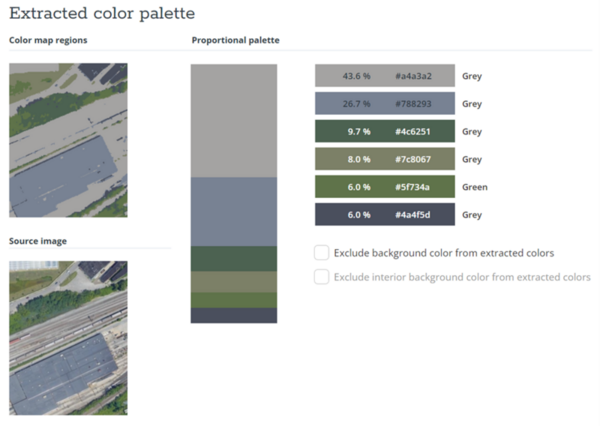
Almost all urban areas face the challenge of urban heat islands, areas with substantially hotter land surface temperatures than the surrounding rural areas. These areas are associated with worse air and water
quality, increased power outages, and increased heat-related illnesses. To learn more about these areas, Ustin et al. analyze satellite images of Cleveland neighborhoods to find out if there is a correlation between surface area development and surface temperature.
Read More...

Using satellite surface temperature data to monitor urban heat island

Meister et al. | Feb 13, 2026

Using satellite surface temperature data to monitor urban heat island
Image credit: Meister, Horvath, and Brown de Colstoun

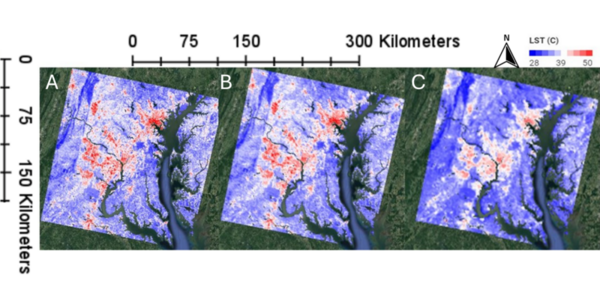
This manuscript investigates the urban heat island (UHI) effect by utilizing two satellite datasets: Landsat (high spatial resolution, lower temporal resolution) and MODIS (lower spatial resolution, high temporal resolution). The authors hypothesized that Landsat would provide better spatial detail, while MODIS would better capture temporal variations. Their analysis in the Washington D.C.–Baltimore region supports these hypotheses, demonstrating that Landsat offers finer spatial details, whereas MODIS provides more consistent seasonal patterns and better detects heatwave frequencies.

Read More...

Scientific project in physics "Carbonated liquids and carbonation level"

Irina et al. | Jan 21, 2024

Scientific project in physics "Carbonated liquids and carbonation level"

In our work we followed the formation of gas bubbles on the surface of the vessel walls in different carbonated liquids, over different time intervals, at different temperatures and in vessels made of different materials. Our results made it possible to identify patterns affecting the process of formation and disappearance of carbon dioxide bubbles.

Read More...

The impact of greenhouse gases, regions, and sectors on future temperature anomaly with the FaIR model

Kosaraju et al. | Jul 29, 2024

The impact of greenhouse gases, regions, and sectors on future temperature anomaly with the FaIR model

This study explores how different economic sectors, geographic regions, and greenhouse gas types might affect future global mean surface temperature (GMST) anomalies differently from historical patterns. Using the Finite Amplitude Impulse Response (FaIR) model and four Shared Socioeconomic Pathways (SSPs) — SSP126, SSP245, SSP370, and SSP585 — the research reveals that future contributions to GMST anomalies.

Read More...

Is Cloud Cover One of the Effects of Climate Change?

Crair et al. | Mar 27, 2014

Is Cloud Cover One of the Effects of Climate Change?

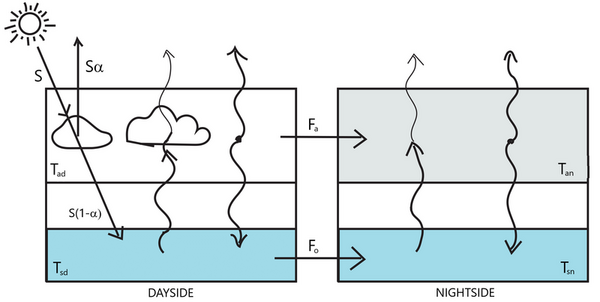
Climate change is one of the most controversial challenges humans face. Here the authors investigate the dual role of clouds - to reflect incoming light away from the Earth and to reflect heat energy back toward the Earth's surface. They find that the amount of incident light energy and surface temperature decreases as the sky becomes cloudier. These results will inform longer-term studies that may compare against the amount of energy clouds reflect back toward the Earth.

Read More...