Browse Articles

Osmotic characteristics of water retention structures of Bursera microphylla in relation to soil salinity

Groom et al. | Jul 12, 2023

Osmotic characteristics of water retention structures of <i>Bursera microphylla</i> in relation to soil salinity
Image credit: Lisa Fotios

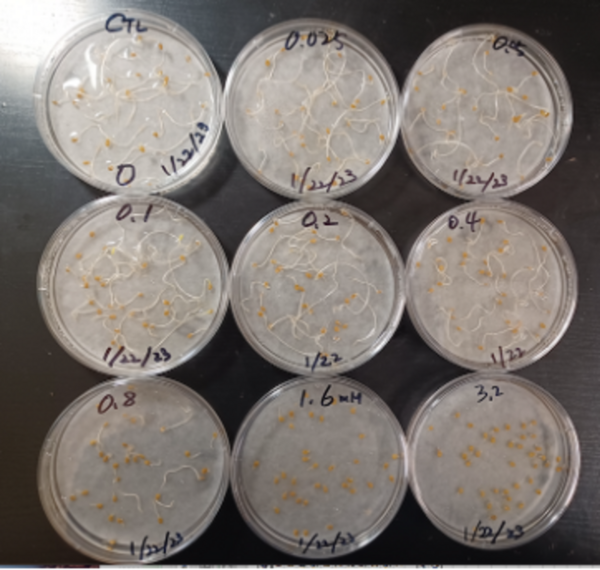
This study hypothesized that sodium chloride was taken up through plant root structures to facilitate water transportation, and that sodium chloride accumulation was directly proportional to the soil salinity. Results showed that most cells within the “bulb” structures were isotonic at a concentration approximately twice as high as that of root tissue and ambient soil salinity, therefore supporting the presented hypothesis.

Read More...

Use of yogurt bacteria as a model surrogate to compare household cleaning solutions

Shukla et al. | May 07, 2023

Use of yogurt bacteria as a model surrogate to compare household cleaning solutions
Image credit: CDC

While resources on the safety of household cleaning products are plentiful, measures of efficacy of these cleaning chemicals against bacteria and viruses remain without standardization in the consumer market. The COVID pandemic has exasperated this knowledge gap, stoking the growth of misinformation and misuse surrounding household cleaning chemicals. Arriving at a time dire for sanitization standardization, the authors of this paper have created a quantifying framework for consumers by comparing a wide range of household cleaning products in their efficacy against bacteria generated by a safe and easily replicable yogurt model.

Read More...

Analyzing resilience in a sample population as a novel qualifier for triage in psychological first aid

Ramesh et al. | Apr 18, 2023

Analyzing resilience in a sample population as a novel qualifier for triage in psychological first aid
Image credit: Mat Napo

While serving as an immediate address for psychological safety and stability, psychological first aid (PFA) currently lacks the incorporation of triage. Without triage, patients cannot be prioritized in correspondence to condition severity that is often called for within emergency conditions. To disentangle the relevance of a potential triage system to PFA, the authors of this paper have developed a method to quantify resilience - a prominent predictor of the capability to recover from a disaster. With this resilience index, they have quantified resilience of differing age, race, and sex demographics to better inform the practice of PFA and potential demographic prioritization via a triage system.

Read More...

Interleukin family (IL-2 and IL-1β) as predictive biomarkers in Indian cancer patients: A proof of concept study

Parthasarathy et al. | Apr 03, 2023

Interleukin family (IL-2 and IL-1β) as predictive biomarkers in Indian cancer patients: A proof of concept study
Image credit: National Cancer Institute

Here, recognizing that the immune response to cancer results in biomarkers that can be used to assess the immune status of cancer patients, the authors investigated the concentrations of key cytokines (TH1 and TH2 cytokines) in healthy controls and cancer patients. They identified significant changes in resting and activated cytokine profiles, suggesting that data of biomarkers such as these could serve as a starting point for further treatment with regard to a patient's specific immune profile.

Read More...

Exponential regression analysis of the Canadian Zero Emission Vehicle market’s effects on climate emissions in 2030

Ajay et al. | Feb 25, 2023

Exponential regression analysis of the Canadian Zero Emission Vehicle market’s effects on climate emissions in 2030
Image credit: Andrew Roberts

Here, the authors explored how the sale and use of electric vehicles could reduce emissions from the transport industry in Canada. By fitting the sale of total of electric vehicles with an exponential model, the authors predicted the number of electric vehicle sales through 2030 and related that to the average emission for such vehicles. Ultimately, they found that the sale and use of electric vehicles alone would likely not meet the 45% reduction in emissions from the transport industry suggested by the Canadian government

Read More...