Optimizing Arthrospira platensis growth for biofuel production via symbiosis between cyanobacteria strains
(1) Saint Francis High School, (2) Dougherty Valley High School, (3) Department of Biology, San Jose City College
https://doi.org/10.59720/25-026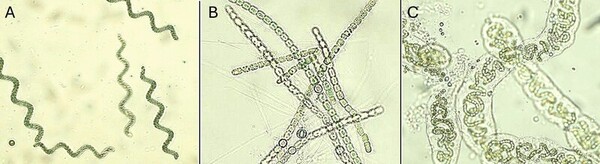
The exacerbation of climate change due to the release of greenhouse gases is leading researchers to explore renewable energy sources such as biofuels, which are near carbon neutral. Producing fuel derived from cyanobacteria, which exhibit rapid growth and minimal growth requirements, circumvents issues caused by conventional biofuel crops. To increase the economic viability of cyanobacterial fuel, we hypothesized that co-culturing Arthrospira platensis, a valuable cyanobacteria genus, with other symbiotic cyanobacteria genera Nostoc sp. and Anabaena sp. would increase culture resilience and A. platensis biomass compared to mono-culturing. We selected Nostoc sp. and Anabaena sp. as secondary species for their unique characteristics, including colony formation and nitrogen-fixing abilities, which enable them to provide nutrients and structural support for other organisms in nature. We used bright-field microscopy, spectrophotometry cell density measurements, and general observations (e.g., color, visual indicators of culture health) to compare mono-cultured A. platensis with its co-cultures containing either Nostoc sp. or Anabaena sp. This study confirms that A. platensis takes advantage of mutualistic relationships and forms a more robust culture alongside Anabaena sp. Specifically, Nostoc sp. and Anabaena sp. reduced invasive species growth and harmful algal blooms. However, Nostoc sp. did not effectively support A. platensis growth, and there were signs of antagonism. Compared to the monocultures, co-cultures with Anabaena sp. demonstrated enhanced resistance to environmental stressors, prolonged culture health even in low-nutrient environments, and increased biomass. These findings suggest that commercial co-culturing of A. platensis with Anabaena sp. could improve the feasibility of cyanobacteria-derived biofuel.
This article has been tagged with: