Browse Articles

Computational Structure-Activity Relationship (SAR) of Berberine Analogs in Double-Stranded and G-Quadruplex DNA Binding Reveals Both Position and Target Dependence

Sun et al. | Dec 18, 2020

Computational Structure-Activity Relationship (SAR) of Berberine Analogs in Double-Stranded and G-Quadruplex DNA Binding Reveals Both Position and Target Dependence

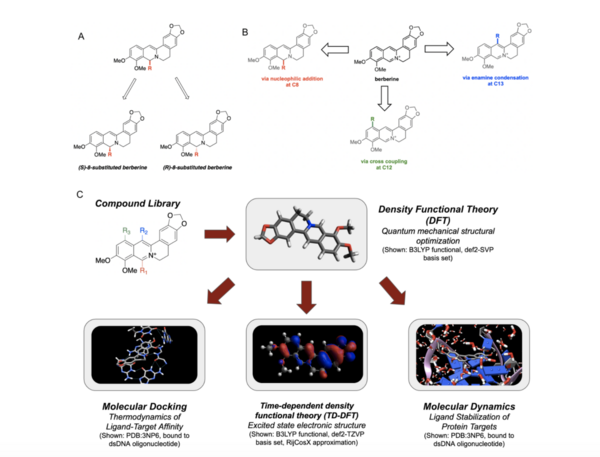
Berberine, a natural product alkaloid, and its analogs have a wide range of medicinal properties, including antibacterial and anticancer effects. Here, the authors explored a library of alkyl or aryl berberine analogs to probe binding to double-stranded and G-quadruplex DNA. They determined that the nature of the substituent, the position of the substituent, and the nucleic acid target affect the free energy of binding of berberine analogs to DNA and G-quadruplex DNA, however berberine analogs did not result in net stabilization of G-quadruplex DNA.

Read More...

Mechanistic deconvolution of autoreduction in tetrazolium-based cell viability assays

Tran et al. | Jul 12, 2024

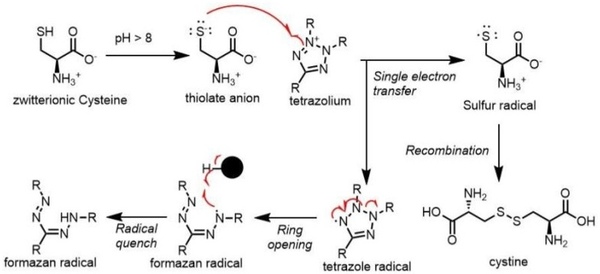
Mechanistic deconvolution of autoreduction in tetrazolium-based cell viability assays

Optical reporters like tetrazolium dyes, exemplified by 5-diphenyl tetrazolium bromide (MTT), are effective tools for quantifying cellular responses under experimental conditions. These dyes assess cell viability by producing brightly-colored formazan dyes when reduced inside active cells. However, certain small molecules, including reducing agents like ascorbic acid, cysteine, and glutathione (GSH), can interfere with MTT assays, potentially compromising accuracy.

Read More...

The sweetened actualities of neural membrane proteins: A computational structural analysis

Chauhan et al. | Nov 03, 2022

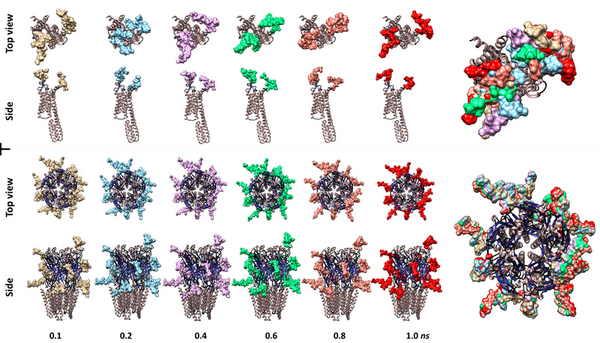
The sweetened actualities of neural membrane proteins: A computational structural analysis

Here, seeking to better understand the roles of glycans in the receptors of active sites of neuronal cells, the authors used molecular dynamics simulations to to uncover the dynamic nature of N-glycans on membrane proteins. The authors suggest the study of theinteractions of these membrane poreins could provide future potential therapeutic targets to treat mental diseases.

Read More...

Homology modeling of clinically-relevant rilpivirine-resistant HIV-RT variants identifies novel rilpivirine analogs with retained binding affinity against NNRTI-resistant HIV mutations

Luk et al. | Jan 24, 2022

Homology modeling of clinically-relevant rilpivirine-resistant HIV-RT variants identifies novel rilpivirine analogs with retained binding affinity against NNRTI-resistant HIV mutations

Human immunodeficiency virus (HIV), which affects tens of millions of individuals worldwide, can lead to acquired immunodeficiency syndrome (AIDS). While there is currently no cure for HIV, the development of small molecule antiretroviral agents has greatly improved the prognosis of infected individuals, especially in developed countries. Here, the authors employ homology modeling and molecular docking towards the identification of novel rilpivirine analogs that retain high binding affinity to clinically relevant rilpivirine-resistant mutations of the HIV reverse transcriptase enzyme.

Read More...

The Non-Thermal Effect of UV-B Irradiation on Onion Growth

Nashnoush et al. | Jun 09, 2020

The Non-Thermal Effect of UV-B Irradiation on Onion Growth

UV-B radiation due to the depletion of ozone threatens plant life, potentially damaging ecosystems and dismantling food webs. Here, the impact of UV-B radiation on the physiology and morphology of Allum cepa, the common onion, was assessed. Mitosis vitality decreased, suggesting UV-B damage can influence the plant’s physiology.

Read More...

Reactivity-informed design, synthesis, and Michael addition kinetics of C-ring andrographolide analogs

Zhou et al. | Nov 17, 2022

Reactivity-informed design, synthesis, and Michael addition kinetics of C-ring andrographolide analogs

Here, based on the identification of androgapholide as a potential therapeutic treatment against cancer, Alzheimer's disease, diabetes, and multiple sclerosis, due to its ability to inhibit a signaling pathway in immune system function, the authors sought ways to optimize the natural product human systems by manipulating its chemical structure. Through the semisynthesis of a natural product along with computational studies, the authors developed an understanding of the kinetic mechanisms of andrographolide and semisynthetic analogs in the context of Michael additions.

Read More...