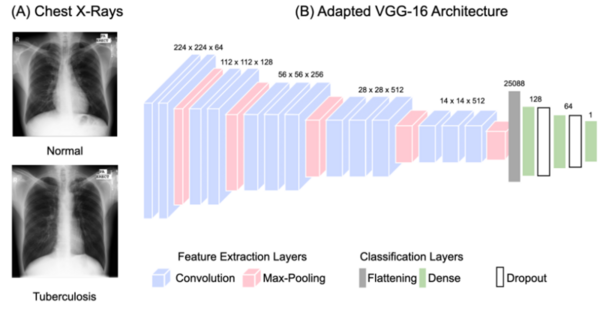
The authors developed and tested machine learning methods to diagnose tuberculosis from pulmonary X-ray scans.
Read More...Effects of data amount and variation in deep learning-based tuberculosis diagnosis in chest X-ray scans
The authors developed and tested machine learning methods to diagnose tuberculosis from pulmonary X-ray scans.
Read More...Depression detection in social media text: leveraging machine learning for effective screening
Depression affects millions globally, yet identifying symptoms remains challenging. This study explored detecting depression-related patterns in social media texts using natural language processing and machine learning algorithms, including decision trees and random forests. Our findings suggest that analyzing online text activity can serve as a viable method for screening mental disorders, potentially improving diagnosis accuracy by incorporating both physical and psychological indicators.
Read More...Determining viability of image processing models for forensic analysis of hair for related individuals
Here, the authors used machine learning to analyze microscopic images of hair, quantifying various features to distinguish individuals, even within families where traditional DNA analysis is limited. The Discriminant Analysis (DA) model achieved the highest accuracy (88.89%) in identifying individuals, demonstrating its potential to improve the reliability of hair evidence in forensic investigations.
Read More...Identifying shark species using an AlexNet CNN model
The challenge of accurately identifying shark species is crucial for biodiversity monitoring but is often hindered by time-consuming and labor-intensive manual methods. To address this, SharkNet, a CNN model based on AlexNet, achieved 93% accuracy in classifying shark species using a limited dataset of 1,400 images across 14 species. SharkNet offers a more efficient and reliable solution for marine biologists and conservationists in species identification and environmental monitoring.
Read More...Evaluating the clinical applicability of neural networks for meningioma tumor segmentation on 3D MRI
Authors emphasize the challenges of manual tumor segmentation and the potential of deep learning models to enhance accuracy by automatically analyzing MRI scans.
Read More...Impact of NaCl concentration in crystalline nanocellulose for printed ionic dielectrics
The authors looked at how the addition of NaCl to crystalline nanocellulose capacitors could improve performance in transistor applications. They found that NaCl can improve performance, but that further work is needed to determine the optimal concentration used depending on the intended application.
Read More...Estimating the liquid jet breakdown height using dimensional analysis with experimental evidence
These authors mathematically deduce a model that explains the interesting (and unintuitive) physical phenomenon that occurs when water falls.
Read More...A chemical and overwintering honey bee apiary field study comparing new and expired amitraz miticide
In this study, the authors test the longevity of a anti-mite compound, amitraz, in commercially-sold strips and the age-dependent efficacy of these strips in preventing honey bee colony collapse by ectoparasitic mite Varroa destructor.
Read More...Copper nanoparticle synthesis using Picea glauca ‘Conica’
The authors propose a method to recycle Christmas tree needles into a non-toxic reducing agent for synthesizing copper nanoparticles.
Read More...Effects of copper sulfate exposure on the nervous system of the Hirudo verbana leech
In this study, the authors test whether excess copper exposure has neurobehavioral effects on Hirudo verbana leeches.
Read More...