Deep learning for pulsar detection: Investigating hyperparameter effects on TensorFlow classification accuracy
(1) Blue Lakes International School, (2) Department of Physics, Stanford University
https://doi.org/10.59720/25-132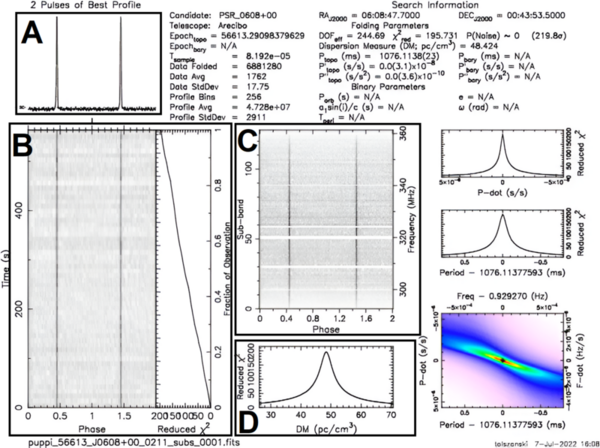
Pulsars play a critical role in astrophysics, serving as natural laboratories for studying extreme states of matter, testing general relativity, and detecting gravitational waves. With the growing volume of pulsar survey data, Convolutional Neural Networks (CNNs) are a promising approach for automating the classification of pulsar candidates. However, CNN performance is influenced by hyperparameters, such as the number of epochs, which refers to one complete iteration through the training data, and batch size. Our investigation aimed to evaluate the influence of these hyperparameters on classification accuracy using prepfold plots. Our hypotheses are as follows: first, that training and testing accuracy would increase with more epochs, and second, that training and testing accuracy would increase with smaller batch sizes. To test our hypotheses, we randomly assigned 140 samples from the Pulsar Science Collaboratory (PSC) database to training (100), validation (20), and testing (20) datasets, and then ran pulsar classification trials using different epoch values and batch sizes. The findings of this study partially support the first hypothesis; classification training and testing accuracy improved as epochs increased, but only until a threshold number of 20 epochs, after which both training and testing accuracy declined. We also found that training and testing accuracy improved with decreasing batch size, thus supporting the second hypothesis. Additionally, the model consistently achieved accuracies exceeding 90% with relatively few epochs. These results confirm the significant role of hyperparameters in determining model accuracy and offer compelling evidence for the viability of automated pulsar candidate classification for real-world applications. Hence, our work provides a basis for advancing high-accuracy pulsar classification models, with the potential of expediting the pulsar discovery process and accelerating astrophysical research.
This article has been tagged with: