Effectiveness of different fabrics in protecting from ultraviolet rays
(1) West Springfield High School
* These authors made equal contributions
https://doi.org/10.59720/24-189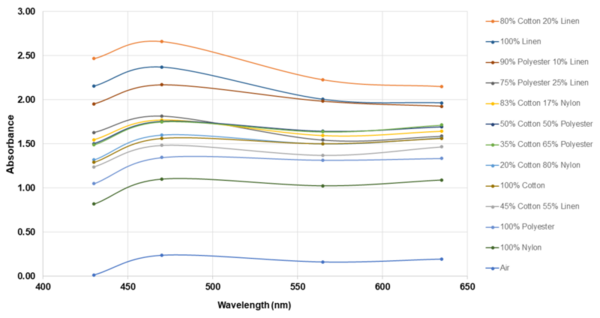
As the ozone layer depletes and leads to greater exposure to ultraviolet (UV) radiation, a common carcinogen, humankind is increasingly susceptible to skin cancer. Additionally, due to rapid production of fabrics, the quantity is prioritized over the quality. We evaluated the effectiveness of different fabrics in protecting from UV radiation. Nylon is a synthetic, outdoor-activewear fabric, polyester is a multi-purpose durable fabric, linen and cotton are breathable, daily-wear fabrics. Based on the applications of these fabrics rather than their chemical properties, we inferred the most to least protective fabrics would be nylon, polyester, cotton, and then linen. Furthermore, we hypothesized blends of nylon and polyester would be the most protective overall while blends of linen and cotton would be the least. However, our results revealed linen, and subsequently cotton, were the most protective pure fabrics with their blend being the most protective. We concluded that blending two natural fibers, like linen and cotton, in optimum proportions produces the best UV-protective fabric since they contain natural-UV absorber lignin. However, blending synthetic and nonsynthetic fabrics generally produces a more protective fabric than their pure counterparts because their blends contain lignin from the pure counterparts, do not degrade in exposure to UV radiation due to the stabilizing effect of the pure counterpart, and contain the more complex molecular structures of the synthetic fabrics. Using this research, manufacturers can produce garments that maintain UV-protective properties, while consumers can make informed decisions to purchase garments.
This article has been tagged with: