Browse Articles

Mitigation of ultraviolet solar radiation involving calcite

Nare et al. | Oct 10, 2026

Mitigation of ultraviolet solar radiation involving calcite

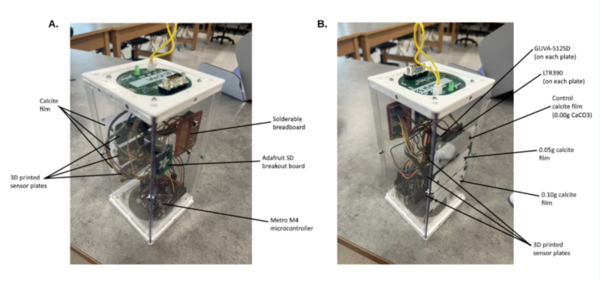
This study tested whether calcite, a safe and naturally occurring mineral, can block ultraviolet (UV) radiation when used in solar geoengineering. Students launched a high‑altitude balloon carrying UV sensors and calcite‑coated sheets to measure how much UV light passed through different calcite concentrations. Their results showed that calcite significantly reduces UV transmission, suggesting it may be a promising material for future stratospheric aerosol injection to help mitigate climate change.

Read More...
Temperature and Precipitation Responses to a Stratospheric Aerosol Geoengineering Experiment Using the Community Climate System Model 4

Anderson et al. | Aug 19, 2014

Temperature and Precipitation Responses to a Stratospheric Aerosol Geoengineering Experiment Using the Community Climate System Model 4

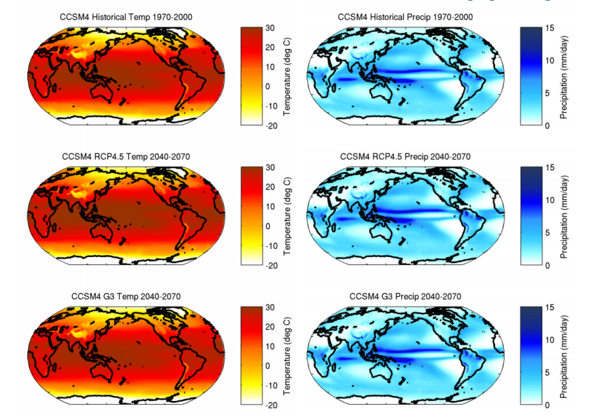
We are changing our environment with steadily increasing carbon dioxide emissions, but we might be able to help. The authors here use a computer program called Community Climate System Model 4 to predict the effects of spraying small particles into the atmosphere to reflect away some of the sun's rays. The software predicts that this could reduce the amount of energy the Earth's atmosphere absorbs and may limit but will not completely counteract our carbon dioxide production.

Read More...

Analysis of the effects of positive ions and boundary layer temperature at various hypersonic speeds on boundary layer density

Selvakumar et al. | Oct 02, 2020

Analysis of the effects of positive ions and boundary layer temperature at various hypersonic speeds on boundary layer density

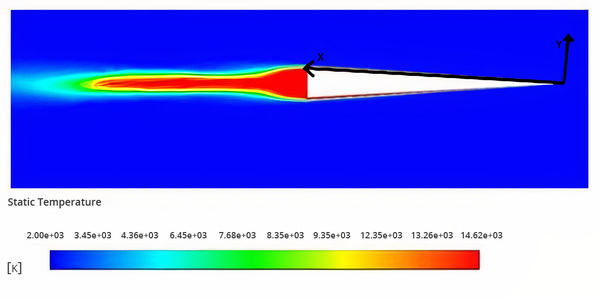
This study's goal was to identify the Mach numbers for which electrostatic drag and heat transfer manipulation would be most applicable inside the stratosphere. The experiments were conducted using computational fluid dynamics software. The study demonstrated that, on average, higher Mach speeds resulted in a considerably higher potential decrease in density. The study highlights that further research on the surface charge method is warranted to explore higher hypersonic speeds within the stratosphere.

Read More...