Browse Articles

A Novel Method for Auto-Suturing in Laparoscopic Robotic-Assisted Coronary Artery Bypass Graft (CABG) Anastomosis

Levy et al. | Jun 21, 2018

A Novel Method for Auto-Suturing in Laparoscopic Robotic-Assisted Coronary Artery Bypass Graft (CABG) Anastomosis

Levy & Levy tackle the optimization of the coronary artery bypass graft, a life-saving surgical technique that treats artery blockage due to coronary heart disease. The authors develop a novel auto-suturing method that saves time, allows for an increased number of sutures, and improves graft quality over hand suturing. The authors also show that increasing the number of sutures from four to five with their new method significantly improves graft quality. These promising findings may help improve outcomes for patients undergoing surgery to treat coronary heart disease.

Read More...

Characterization of a UPEC DegS Mutant in vitro and in vivo

Bradley et al. | Mar 16, 2015

Characterization of a UPEC <em>DegS</em> Mutant <em>in vitro</em> and <em>in vivo</em>

DegS is an integral inner membrane protein in E. coli that helps break down misfolded proteins. When it is mutated, there is a large increase in the production of outer membrane vesicles (OMVs), which are thought to play a role in pathogenesis. This study used mutant strains of uropathogenic E. coli (UPEC) to characterize the role of DegS and OMVs on UPEC virulence.

Read More...

The effect of bioenhancers on ampicillin-sulbactam as a treatment against A. baumannii

Balaji et al. | Sep 21, 2024

The effect of bioenhancers on ampicillin-sulbactam as a treatment against <i>A. baumannii<i>

This article explores the potential of piperine, a bioenhancer from black pepper, to improve antibiotic efficacy against antibiotic-resistant Acinetobacter baumannii. By combining piperine with ampicillin-sulbactam, the study demonstrated a significant reduction in bacterial growth for most strains tested, showcasing the promise of bioenhancers in combating resistant pathogens. This research highlights the possibility of reducing the required antibiotic dosage, potentially offering a new strategy in the fight against drug-resistant bacteria.

Read More...

Quantitative NMR spectroscopy reveals solvent effects in the photochemical degradation of thymoquinone

Mandava et al. | Dec 16, 2023

Quantitative NMR spectroscopy reveals solvent effects in the photochemical degradation of thymoquinone

Thymoquinone is a compound of great therapeutic potential and scientific interest. However, its clinical administration and synthetic modifications are greatly limited by its instability in the presence of light. This study employed quantitative 1H nuclear magnetic resonance (NMR) spectroscopy to identify the effect of solvation on the degradation of thymoquinone under ultraviolet light (UV). It found that the rate of degradation is highly solvent dependent occurs maximally in chloroform.

Read More...

Comparing Virulence of Three T4 Bacteriophage Strains on Ampicillin-Resistant and Sensitive E. coli Bacteria

Hudanich et al. | Dec 09, 2020

Comparing Virulence of Three T4 Bacteriophage Strains on Ampicillin-Resistant and Sensitive <em>E. coli</em> Bacteria

In this study, the authors investigate an alternative way to kill bacteria other than the use of antibiotics, which is useful when considering antibiotic-resistance bacteria. They use bacteriophages, which are are viruses that can infect bacteria, and measure cell lysis. They make some important findings that these bacteriophage can lyse both antibiotic-resistant and non-resistant bacteria.

Read More...

Talinum paniculatum root exhibits synergistic antimicrobial activity with Tetracycline, Erythromycin, and Streptomycin against S. aureus but has no observed effect on antibiotic efficacy against E. coli

Patel et al. | Jan 09, 2018

Talinum paniculatum root exhibits synergistic antimicrobial activity with Tetracycline, Erythromycin, and Streptomycin against S. aureus but has no observed effect on antibiotic efficacy against E. coli

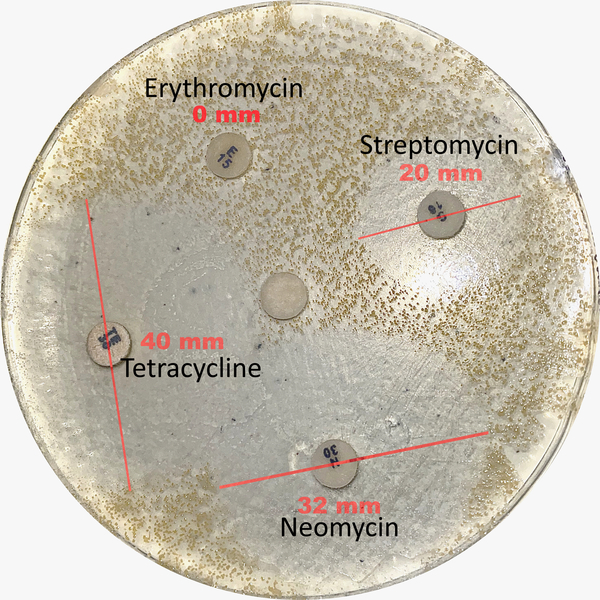
Patel et al. explore whether T. paniculatum plant extract can work with modern antibiotics to increase antibiotic efficacy against common disease-causing bacteria. The plant extract in conjunction with the antibiotic shows promise in battling S. aureus. The authors present a cost-effective method to increase antibiotic efficacy in a time where antibiotic resistant bacteria is becoming a growing problem.

Read More...

Determining the Habitable Zone Around a Star

Lee et al. | May 29, 2013

Determining the Habitable Zone Around a Star

Life requires many things, including a hospitable temperature, elements, and energy. Here the authors utilize Newton's laws of physics and information relating a star's luminosity and temperature to determine the minimum and maximum masses and luminosities of planets and stars that would support life as we know it. This work can be used to determine the likelihood of a planet being able to support life based on attributes we can measure from here on Earth.

Read More...

Impact of Population Density and Elevation on Tuberculosis Spread and Transmission in Maharashtra, India

Rao et al. | Nov 07, 2021

Impact of Population Density and Elevation on Tuberculosis Spread and Transmission in Maharashtra, India

India accounts for over 2.4 million recorded cases of tuberculosis, about 26% of the world’s cases. This research ascertained the bearing of both the population density and the average elevation above mean sea level (MSL) on the number of cases of TB recorded by the districts in Maharashtra, India. The results found a strong positive correlation between the number of TB cases per thousand people and the population density and a strong negative correlation between the number of TB cases per thousand people and the average elevation above MSL.

Read More...