Browse Articles

Population Forecasting by Population Growth Models based on MATLAB Simulation

Li et al. | Aug 31, 2020

Population Forecasting by Population Growth Models based on MATLAB Simulation

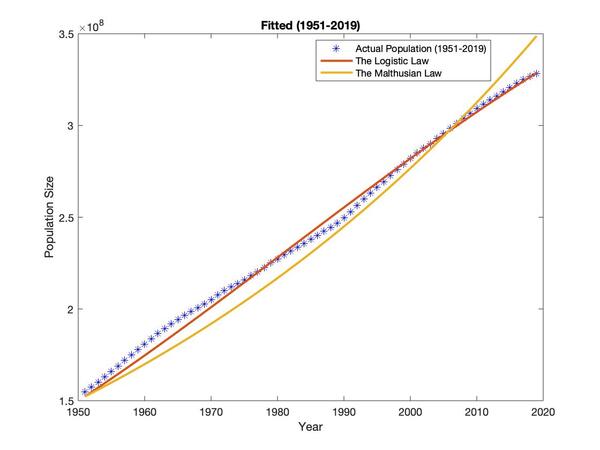
In this work, the authors investigate the accuracy with which two different population growth models can predict population growth over time. They apply the Malthusian law or Logistic law to US population from 1951 until 2019. To assess how closely the growth model fits actual population data, a least-squared curve fit was applied and revealed that the Logistic law of population growth resulted in smaller sum of squared residuals. These findings are important for ensuring optimal population growth models are implemented to data as population forecasting affects a country's economic and social structure.

Read More...

Public Perception of the Effects of Artificial Sweeteners on Diabetes Based on YouTube Comments

Kim et al. | Jun 25, 2024

Public Perception of the Effects of Artificial Sweeteners on Diabetes Based on YouTube Comments
Image credit: The authors

Artificial sweeteners are rising in popularity, in part due to the influence of social media platforms like YouTube. However, YouTube commenters often repeat information about artificial sweeteners that is not supported by scientific research. To investigate how misinformation about sweeteners spreads through social media, Kim and Yoo conduct a content analysis of YouTube comments to reveal how many comments repeat misinformation about artificial sweeteners' effects.

Read More...

Using NLP to ascertain changes in the fast-fashion industry based on UN sustainable development goals

Chadha et al. | Sep 11, 2023

Using NLP to ascertain changes in the fast-fashion industry based on UN sustainable development goals
Image credit: Prudence Earl

Here, the authors sought to evaluate the efforts of fast fashion clothing companies towards sustainability, specifically in regards to the United Nations Sustainable Development Goals. The authors used natural language processing to investigate the sustainability reports of fast fashion companies focusing on terms established by the UN. They found that the most consistently addressed areas were related to sustainable consumption/production, with a focus on health and well-being emerging during the recent pandemic.

Read More...

A novel encoding technique to improve non-weather-based models for solar photovoltaic forecasting

Ahmed et al. | Jun 09, 2023

A novel encoding technique to improve non-weather-based models for solar photovoltaic forecasting

Several studies have applied different machine learning (ML) techniques to the area of forecasting solar photovoltaic power production. Most of these studies use weather data as inputs to predict power production; however, there are numerous practical issues with the procurement of this data. This study proposes models that do not use weather data as inputs, but rather use past power production data as a more practical substitute to weather-based models. Our proposed models demonstrate a better, cheaper, and more reliable alternatives to current weather models.

Read More...

Spectrophotometric comparison of 4-Nitrophenyl carbonates & carbamates as base-labile protecting groups

Kocalar et al. | Dec 12, 2022

Spectrophotometric comparison of 4-Nitrophenyl carbonates & carbamates as base-labile protecting groups

In organic synthesis, protecting groups are derivatives of reactive functionalities that play a key role in ensuring chemoselectivity of chemical transformations. To protect alcohols and amines, acid-labile tert-butyloxycarbonyl protecting groups are often employed but are avoided when the substrate is acid-sensitive. Thus, orthogonal base-labile protecting groups have been in demand to enable selective deprotection and to preserve the reactivity of acid-sensitive substrates. To meet this demand, we present 4-nitrophenyl carbonates and carbamates as orthogonal base-labile protecting group strategies.

Read More...

Development and Implementation of Enzymatic and Volatile Compound-based Approaches for Instantaneous Detection of Pathogenic Staphylococcus aureus

Nori et al. | Feb 20, 2021

Development and Implementation of Enzymatic and Volatile Compound-based Approaches for Instantaneous Detection of Pathogenic <i>Staphylococcus aureus</i>

Staphylococcus aureus (S. aureus) has a mortality rate of up to 30% in developing countries. The purpose of this experiment was to determine if enzymatic and volatile compound-based approaches would perform more quickly in comparison to existing S. aureus diagnostic methods and to evaluate these novel methods on accuracy. Ultimately, this device provided results in less than 30 seconds, which is much quicker than existing methods that take anywhere from 10 minutes to 48 hours based on approach. Statistical analysis of accuracy provides preliminary confirmation that the device based on enzymatic and volatile compound-based approaches can be an accurate and time-efficient tool to detect pathogenic S. aureus.

Read More...