Browse Articles

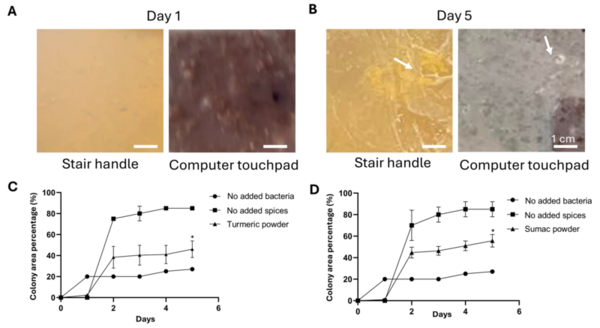
The growth of bacteria on everyday objects and the antimicrobial effects of household spices

Daehan Yi et al. | Apr 29, 2026

The growth of bacteria on everyday objects and the antimicrobial effects of household spices
Image credit: Daehan Yi, Boughaleb Hassani and Ribeiro

The study investigates the antibacterial properties of household spices on bacteria isolated from everyday objects, aiming to address the limited understanding of bacterial resilience on surfaces and the potential of spices as antibacterial agents. Researchers hypothesized that bacteria would grow faster on some surfaces than others and that spices like honey, chili powder, turmeric, and sumac would inhibit bacterial growth at varying rates. The findings suggest that household spices possess significant antibacterial properties and could be used as emergency disinfectants, particularly in under-resourced settings. However, they cannot replace medical treatments but offer insights into alternative health solutions using common ingredients.

Read More...

A study of Syrian students' migration motivations, destinations, and return intentions in a time of crisis

Merjaneh et al. | Apr 16, 2026

A study of Syrian students' migration motivations, destinations, and return intentions in a time of crisis
Image credit: Aaron Burden, 2017

This study investigates the migration intentions of Syrian high school and university students amid ongoing conflict and economic instability. Drawing on survey data, the research examines how academic stage influences migration motivations, preferred destinations, and return intentions. The findings reveal a widespread desire to emigrate, driven by educational, economic, and security concerns, highlighting significant implications for Syria’s future workforce and post-conflict recovery.

Read More...

Effects of plant-derived smoke water on germination and growth in stressed plants

Ge et al. | Apr 08, 2026

Effects of plant-derived smoke water on germination and growth in stressed plants

Here the authors investigated the potential of plant-derived smoke water to mitigate the negative impacts of abiotic stressors, such as heat, salinity, and water fluctuations, on the germination and growth of various agricultural crops. Their findings suggest that smoke water, specifically from buckwheat, pea, and radish, significantly improves plant resilience against drought and excessive water stress, offering a viable strategy to bolster food security in the face of climate change.

Read More...

Innovative use of recycled textile fibers in building materials: A circular economy approach

Gupta et al. | Feb 19, 2026

Innovative use of recycled textile fibers in building materials: A circular economy approach
Image credit: Gupta and Gupta

Textile waste from the fashion industry is a major environmental pollutant, but recycling waste into novel building material is a strategy to reduce the negative effects. This manuscript characterized five different binders that can be used to repurpose textile waste into bricks for construction purposes. Water-based glue, cement, white cement, plaster of Paris, and epoxy resin were mixed with shredded textile waste, and the mechanical characteristics and thermal insulation of each brick type were measured. Bricks with increased mechanical strength had the poorest thermal resistance, and the contrasting properties would suit different building purposes. This work provides a first step in generating recycled textile bricks for construction in a circular economy framework.

Read More...

Utilizing sorbitol to improve properties of cellulose-based biodegradable hydrogels

Adler et al. | Jan 06, 2025

Utilizing sorbitol to improve properties of cellulose-based biodegradable hydrogels

Hydrogels are commonly used in medicine, pharmaceuticals, and agriculture. Hydrogels absorb water by swelling and re-release this water by diffusion. This study sought to synthesize a biodegradable, cellulose-based hydrogel that is more effective at absorbing and re-releasing water than those produced by current methods. We tested the compressive strength of both the dry and swollen gels and the tensile strength of the swollen gels to elucidate the gel structure.

Read More...

Part of speech distributions for Grimm versus artificially generated fairy tales

Arvind et al. | Nov 16, 2024

Part of speech distributions for Grimm versus artificially generated fairy tales
Image credit: Nayalia Y.

Here, the authors wanted to explore mathematical paradoxes in which there are multiple contradictory interpretations or analyses for a problem. They used ChatGPT to generate a novel dataset of fairy tales. They found statistical differences between the artificially generated text and human produced text based on the distribution of parts of speech elements.

Read More...