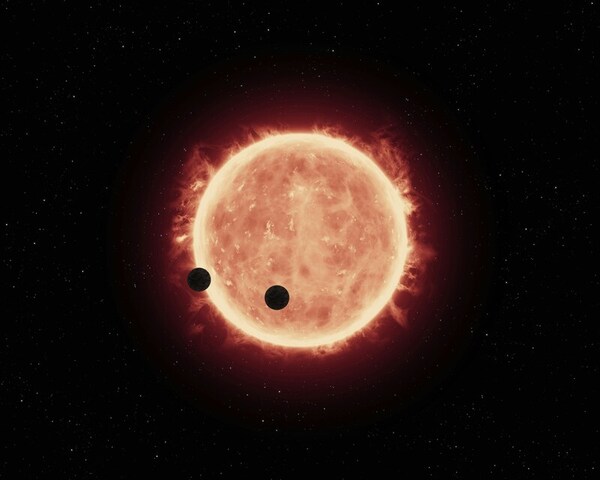
The authors looked at what conditions with host stars favor development of exoplanets.
Read More...Differentiating characteristics in exoplanet host stars
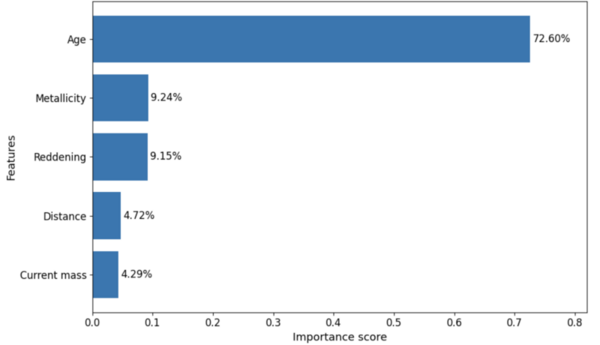
The authors looked at what conditions with host stars favor development of exoplanets.
Read More...The velocity of white dwarf stars relates to their magnitude
Using the European Space Agency’s Gaia dataset, the authors analyzed the relationship between white dwarfs’ magnitudes and proper motions. They hypothesized that older white dwarf stars may have different velocities than younger ones, possibly that stars slow down as they age. They found that the white dwarfs in the dataset were substantially redder and higher magnitude (traits traditionally associated with older stars) as compared to their non-fast counterparts.
Read More...Alterations of the [Fe/H] Values Modulate Light Curves by Absolute Magnitude in non-Blazhko RRab Lyraes
In this study, the authors investigate the relationship between iron/hydrogen ratio [Fe/H] of a type of variable stars commonly used as reference points RR Lyrae stars and their light curves to see if one can determine the composition of these stars solely by measuring their light curve characteristics.
Read More...Defying chemical tagging: inhomogeneities in the wide binary system HIP 34407/HIP 34426
This assessed the hypothesis that stars in wide binary systems are chemically homogeneous because of their shared origin. Abundances of the HIP 34407/HIP 34426 binary were obtained by analyzing high-resolution spectra of the system. Discrepancies found in the system’s elemental abundances might be an indicator of the presence of rocky planets around this star. Thus, the differences found in chemical composition might demonstrate limitations in the assumptions of chemical tagging.
Read More...Effect of fuel density and temperature on helium-3 fusion reaction rates in stellar cores
This paper discusses how the conditions at the center of stars affects the nuclear reactions that happen inside these stars. We focused on the effect of temperature and density and found that these two properties interacted to create a greater effect when combined than when separate.
Read More...Exploration of the density–size correlation of celestial objects on various scales
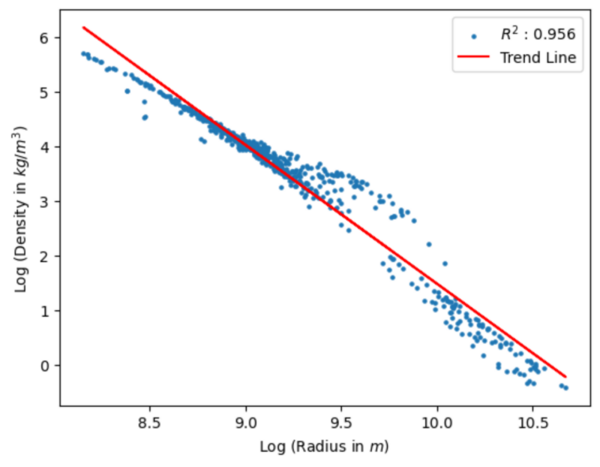
Building on previous work by earlier astronomers, the authors investigate the correlation between the density and size of celestial objects in the universe, including neutron stars, galaxies, and galaxy clusters.
Read More...Can the attributes of an app predict its rating?
In this article the authors looked at different attributes of apps within the Google Play store to determine how those may impact the overall app rating out of five stars. They found that review count, amount of storage needed and when the app was last updated to be the most influential factors on an app's rating.
Read More...Analysis of the Exoplanet HD 189733b to Confirm its Existence
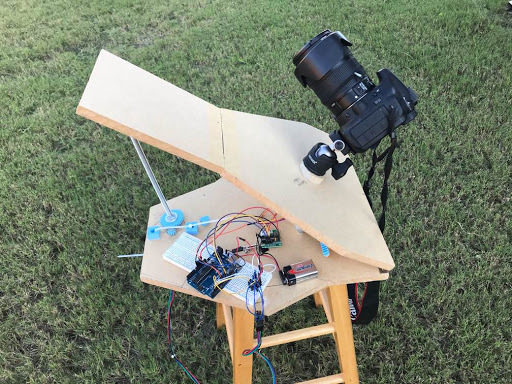
In this study, the authors study features of exoplanet 189733 b. This exoplanet, or planets that orbit stars other than the Sun, is found in the HD star system. Using a DSLR camera, they constructed a high caliber exoplanet transit detection tracker to study the orbital periods, radial velocity, and photometry of 189733 b. They then compared results from their system to data collected by other high precision studies. What they found was that their system produced results supporting previously published studies. These results are exciting results from the solar system demonstrating the importance of validating radial velocity and photometry data using high-precision studies.
Read More...An Analysis on Exoplanets and How They are Affected by Different Factors in Their Star Systems
In this article, the authors systematically study whether the type of a star is correlated with the number of planets it can support. Their study shows that medium-sized stars are likely to support more than one planet, just like the case in our solar system. They predict that, of the hundreds of planets beyond our solar system, 6% might be habitable. As humans work to travel further and further into space, some of those might truly be suited for human life.
Read More...Determining the Habitable Zone Around a Star
Life requires many things, including a hospitable temperature, elements, and energy. Here the authors utilize Newton's laws of physics and information relating a star's luminosity and temperature to determine the minimum and maximum masses and luminosities of planets and stars that would support life as we know it. This work can be used to determine the likelihood of a planet being able to support life based on attributes we can measure from here on Earth.
Read More...