Investigating the contribution of genetic risk factors to gastric cancer in Korean-ancestry populations
(1) Design Tech High School, (2) Institute of Vertebrate Paleontology and Paleoanthropology, Chinese Academy of Sciences
https://doi.org/10.59720/25-319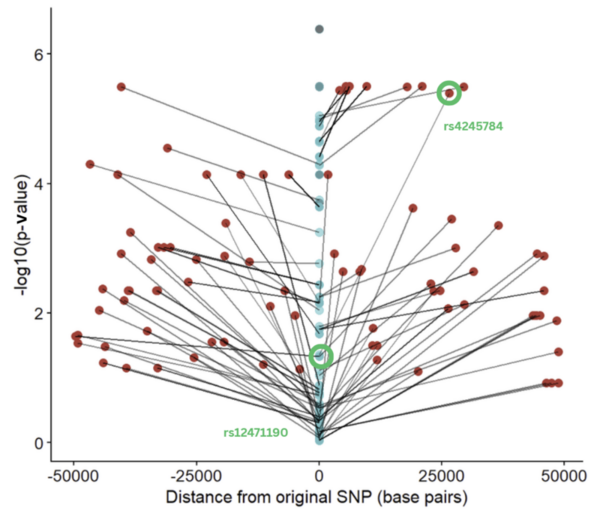
Korean-ancestry populations and East Asians broadly have had historically high rates of gastric cancer. Genetic contributors to this high incidence have not been thoroughly explored in Koreans. This project investigated whether previously identified genetic risk factors in non-Korean populations were associated with high gastric cancer incidence rates in Koreans. We hypothesized that there would be higher risk allele frequencies for gastric cancer in Koreans, and that most single-nucleotide polymorphisms (SNPs) identified in other populations as being associated with gastric cancer would have concordant effects in a Korean population. Using public genome-wide association study (GWAS) data, we conducted three analyses. First, our remapping analysis identified 120 SNPs that are more closely linked in Koreans compared to the causal variants for gastric cancer that are shared across populations. Second, our direction of effect analysis revealed that 68.42% of significant SNPs exhibited consistent effects across South Korean and other populations. Lastly, East Asian populations in the 1000 Genomes Project did not show significantly higher average risk allele frequencies for gastric cancer-associated SNPs compared to other populations, which could indicate that environmental factors play a larger role or that key causal variants remain unidentified. While known gastric cancer SNPs implicated in non-Korean populations appear to have consistent effects in ethnically Korean populations, different tag SNPs in Korean populations may be more strongly linked to the underlying causal variants. The role of genetics in the high gastric cancer incidence observed in East Asian populations appears limited based on comparisons of risk allele frequencies across populations.
This article has been tagged with: