Mapping equity in California K-12 school solar adoption using computer vision
(1) Amador Valley High School, (2) Civil and Environmental Engineering, Stanford University
https://doi.org/10.59720/25-188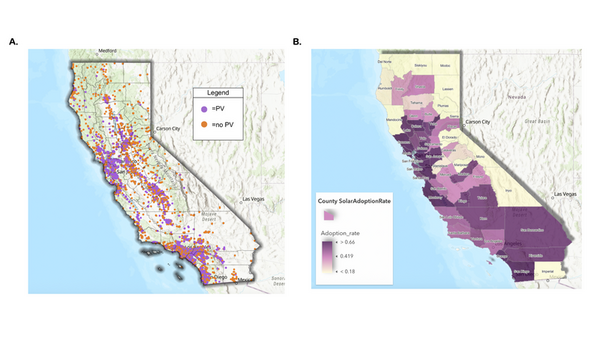
California is experiencing dramatic impacts from the climate crisis, facing wildfires, droughts, and power outages. In response, the state has prioritized clean and resilient energy, and solar photovoltaic (PV) power systems are a widely adopted solution. However, insight about solar adoption—an essential community resource—at educational institutions is lacking. We hypothesized that K-12 schools in California with lower percentages of socioeconomically disadvantaged students were more likely to adopt solar PV systems than schools serving higher percentages of disadvantaged students. To investigate this hypothesis, our study used a machine learning pipeline to identify solar PV installations from satellite and aerial imagery for all of California’s public K-12 schools. Notably, we found a majority (55% or 5,503 out of 9,996 schools) of schools adopted solar in California, which was higher than any previous reporting. However, solar adoption is uneven: schools with 10% or less socioeconomically disadvantaged students exhibit much higher solar adoption percentages (69-73%) compared to those with over 90% disadvantaged students having much lower percentages (46%). Rural, forested Northern California counties, which also suffer from more frequent and prolonged power outages, also were associated with lower rates of solar adoption. We created an open-source interactive dashboard to help policymakers, school communities, and others understand K-12 solar PV adoption patterns and promote future policy interventions to support widespread solar adoption.
This article has been tagged with: