Assessing the accuracy and efficiency of simplified gridded ion thruster simulations
(1) Bloomfield Hills High School, (2) Department of Aeronautics and Astronautics, Stanford University
https://doi.org/10.59720/24-381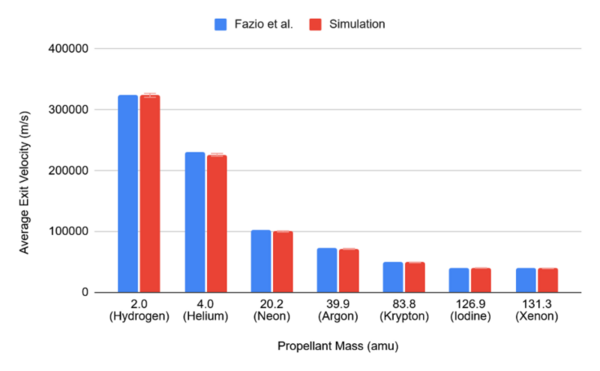
Electric propulsion is a method of spacecraft propulsion, where thrust is generated by accelerating ionized gas using electric fields. It is an essential part of deep space mobility, being far more fuel and space efficient than combustion thrusters. Gridded ion thrusters are a common mean of achieving electric propulsion, utilizing multiple grids with a voltage difference to accelerate ions. Because electric propulsion mainly employs electrostatic forces, which are easily controlled, it is easier to simulate than chemical propulsion, which requires the determination of reaction rates, collisions and internal pressure forces. Thus, a large amount of electric propulsion research is conducted through simulations, iterating tests in order to optimize thruster designs. However, highly accurate simulations require large computational resources to mitigate numerical noise. Naturally, it would be useful to find any way to minimize computation times while still producing accurate data. To explore this concept, we created a particle-in-cell simulation which deliberately underresolves particle statistics to determine the effects on extensive and intensive metrics. We hypothesized that intrinsic values would still be accurate while extrinsic values would diverge greatly. We normalized the results by a reference value and quantitatively compared them to the experimental data, which showed that intensive properties like specific impulse and velocity retained high accuracy with low particle number. Our findings suggest that preliminary simulations could be run quickly with much lower particle counts before more technically demanding and comprehensive simulations are performed.
This article has been tagged with: