Browse Articles

The role of xpa-1 and him-1 in UV protection of Caenorhabditis elegans

Tung et al. | Feb 25, 2022

The role of <em>xpa-1</em> and <em>him-1</em> in UV protection of <em>Caenorhabditis elegans</em>

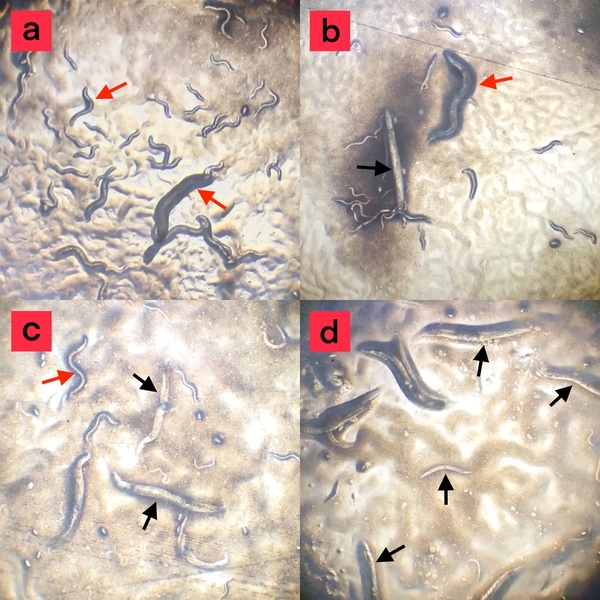
Caenorhabditis elegans xpa-1 and him-1 are orthologs of human XPA and human SMC1A, respectively. Mutations in the XPA are correlated with Xeroderma pigmentosum, a condition that induces hypersensitivity to ultraviolet (UV) radiation. Alternatively, SMC1A mutations may lead to Cornelia de Lange Syndrome, a multi-organ disorder that makes patients more sensitive to UVinduced DNA damage. Both C. elegans genes have been found to be involved in protection against UV radiation, but their combined effects have not been tested when they are both knocked down. The authors hypothesized that because these genes are involved in separate pathways, the simultaneous knockdown of both of these genes using RNA interference (RNAi) in C. elegans will cause them to become more sensitive to UV radiation than either of them knocked down individually. UV protection was measured via the percent survival of C. elegans post 365 nm and 5.4x10⁻¹⁹ joules of UV radiation. The double xpa-1/him-1 RNAi knockdown showed a significantly reduced percent survival after 15 and 30 minutes of UV radiation relative to wild-type and xpa-1 and him-1 single knockdowns. These measurements were consistent with their hypothesis and demonstrated that xpa-1 and him-1 genes play distinct roles in resistance against UV stress in C. elegans. This result raises the possibility that the xpa-1/him-1 double knockdown could be useful as an animal model for studying the human disease Xeroderma pigmentosum and Cornelia de Lange Syndrome.

Read More...
The Potential of Fibroblast Growth Factors to Stimulate Hair Growth In Vitro

Cheng et al. | Nov 07, 2021

The Potential of Fibroblast Growth Factors to Stimulate Hair Growth In Vitro

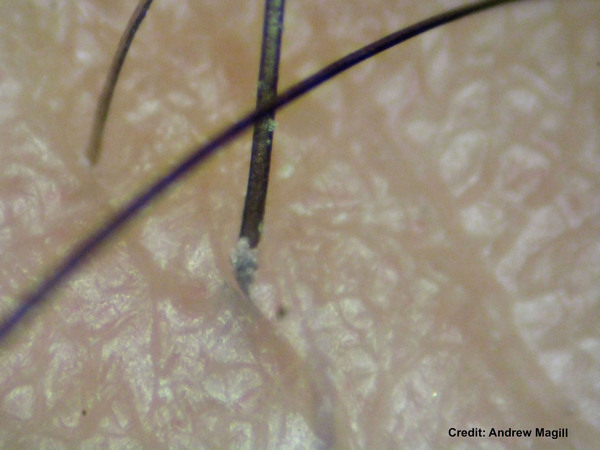
Identifying treatments that can stimulate hair growth use could help those struggling with undesirable hair loss. Here, the authors show that Fibroblast Growth Factors can stimulate the division of cells isolated from the mouse hair follicle. Their results suggest that this family of growth factors might be helpful in stimulating hair growth in living animals as well.

Read More...

Deep learning for pulsar detection: Investigating hyperparameter effects on TensorFlow classification accuracy

Upadhyay et al. | Jan 31, 2026

Deep learning for pulsar detection: Investigating hyperparameter effects on TensorFlow classification accuracy

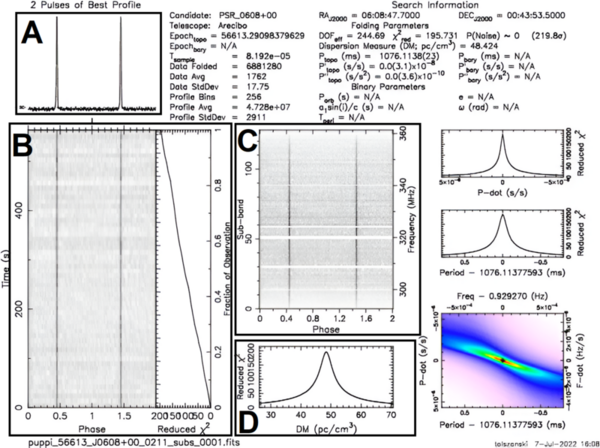
This study investigates how the hyperparameters epochs and batch size affect the classification accuracy of a convolutional neural network (CNN) trained on pulsar candidate data. Our results reveal that accuracy improves with increasing number of epochs and smaller batch sizes, suggesting that with optimized hyperparameters, high accuracy may be achievable with minimal training. These findings offer insights that could help create more efficient machine learning classification models for pulsar signal detection, with the potential of accelerating pulsar discovery and advancing astrophysical research.

Read More...

The influence of music on lexical decision-making in adolescents

Fisher et al. | Apr 28, 2024

The influence of music on lexical decision-making in adolescents

The lexical decision task is designed to test aspects of vocabulary retrieval from short-term and long-term memory by prompting the subject to differentiate between words and non-words. From this task, researchers can determine the effects of certain stimuli on linguistic processing. Numerous studies have investigated the effects of music on various cognitive capacities, like memory and vocabulary. In the current study, we hypothesized that participants would show greater accuracy rates on the lexical decision task when exposed to a selected piece of classical music while completing the task, as compared to completing the task in silence. We tested this hypothesis on a group of 25 participants who completed the lexical decision task once in silence and once while listening to Beethoven's “Moonlight Sonata, 1st Movement”. The results suggest a positive association between the effects of classical background music and improved accuracy. Our results indicate that listening to certain types of music may enhance linguistic processes such as reading and writing. Further research with a larger group of participants is necessary to better understand the association between music and linguistic processing abilities.

Read More...

Researching the research enthusiasts: examining their motivation and the impact of a successful role model

Jubair et al. | Sep 18, 2024

Researching the research enthusiasts: examining their motivation and the impact of a successful role model
Image credit: The authors

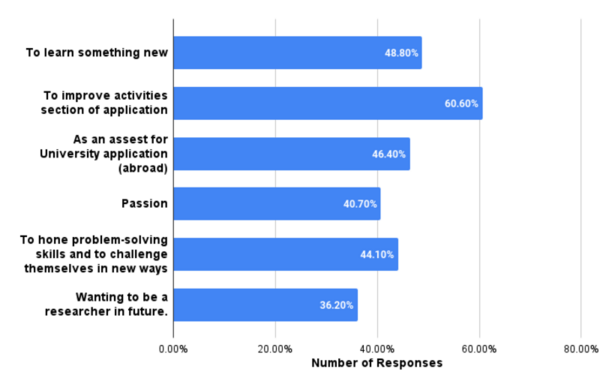
High school and university students have various motivations for participating in research, ranging from strengthening their applications for university to building skills for a research career. Jubair and Islam survey Bangladeshi high school and university students to uncover their motivations and inspirations for participating in research.

Read More...

The Effect of Lyrical and Instrumental Music on Reading Comprehension Tasks

Herring et al. | Nov 01, 2018

The Effect of Lyrical and Instrumental Music on Reading Comprehension Tasks

Herring and Scott investigated how specific types of background music affected 8th and 9th graders' performance on a reading comprehension task. In the study, their results indicated that music with English lyrics led to lower reading comprehension scores, while foreign language and instrumental music was comparable to no music at all. The authors therefore recommend that teachers avoid playing English language music for students completing reading tasks in order to minimize distractions and improve work efficiency.

Read More...