How teaching style influences math learning: Comparing discovery and traditional instruction
(1) M. Emin Sarac Anatolian Imam Hatip High School, Istanbul, (2) Department of Veterinary Medicine, Kastamonu University
https://doi.org/10.59720/26-043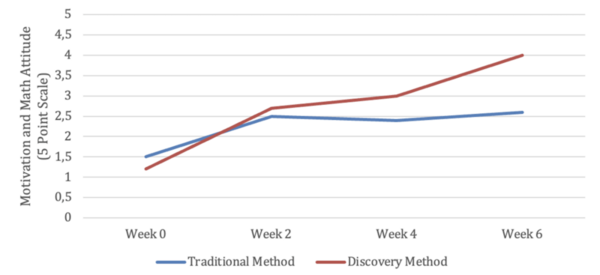
Mathematics achievement and engagement often decline as students move through secondary school, and the way mathematics is taught may be part of the reason. In this study, we compared traditional direct teaching with discovery-based teaching in mathematics among secondary school students. Forty seventh-grade students from across Turkiye participated in a six-week virtual mathematics enrichment course on basic linear equations and combinatorics. We randomly assigned the students to two equal-sized groups that received different instructional approaches to the same content for an equivalent period of time. The teacher taught one group through structured explanations and worked examples, while the other group learned by exploring problems with guidance and feedback from the teacher. We hypothesized that students receiving discovery-based teaching would demonstrate better academic achievement and more positive attitudes towards mathematics compared to students receiving traditional teaching. We collected data using pre- and post-instruction mathematics achievement tests that assessed procedural and conceptual knowledge, alongside a mathematics attitude scale. After accounting for the differences between the two groups before instruction began, students in the discovery-based group achieved significantly higher mathematics scores. Furthermore, students who received discovery-based teaching reported better attitudes towards mathematics. Overall, the results indicate that supporting students’ independent discovery of mathematical concepts benefits both learning and attitudes in online learning settings.
This article has been tagged with: