Upregulation of the AP-1 complex as a potential biomarker for Alzheimer’s disease (AD)
(1) BASIS Independent Fremont, (2) Academy for Science and Design, (3) Lambert High School, (4) Bridgeland High School, (5) University of California: San Diego, (6) miRcore
https://doi.org/10.59720/25-252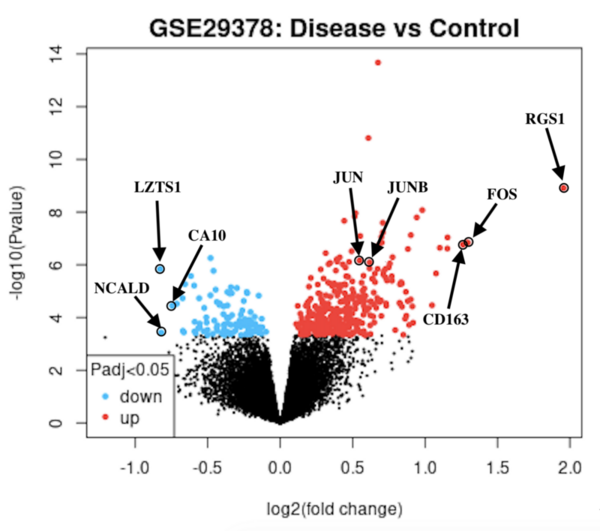
Alzheimer’s disease (AD) is a major neurodegenerative disorder caused by the structural protein buildup of neuritic plaques and tangles, which lead to neuronal death. AD symptoms may be exacerbated by inflammation, an immune response which can accelerate plaque formation. This plaque formation, also known as atherogenesis, reduces blood flow throughout the body and to neurons, which can worsen AD significantly. Because of the association between inflammation, atherogenesis, and AD, we hypothesized that genetic biomarkers present in inflammation and atherogenesis pathways could also be used for AD diagnosis. To test our hypothesis, we analyzed hippocampal expression data from AD and control patients to determine the most statistically significant differentially expressed genes. We analyzed the top 250 differentially expressed genes by significance to create a gene product interaction network graph, and we performed enrichment testing, which allowed us to identify enriched biological pathways and processes. Two enriched pathways were the inflammatory IL-17 signaling pathway and the fluid shear stress and atherosclerosis pathway, which shared enriched expression of genes whose protein products compose the Activator Protein 1 (AP-1) transcription complex. The increased activity of the AP-1 transcription complex, as well as the upregulation of inflammation and atherosclerosis, supports our hypothesis that biomarkers involved in inflammatory and atherosclerotic pathways can be used to predict AD in asymptomatic individuals. These results can be further investigated in future studies to determine whether the AP-1 complex can be targeted for therapies to reduce or reverse the symptoms of AD.
This article has been tagged with: