Evaluating key factors in emotion detection models for AI-driven personalized bibliotherapy
(1) Emerald High School
https://doi.org/10.59720/25-129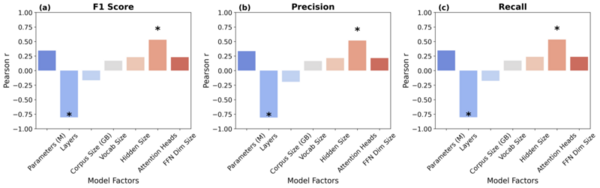
Mental health challenges are becoming a serious problem globally, showcasing the need for more accessible and personalized forms of treatment. Bibliotherapy, the use of books to support one’s emotional state, is a promising solution. However, traditional methods often lack personalization in their approach, using static reading lists that do not adapt to the reader. This study evaluates the potential of natural language processing (NLP) models in an emotion-driven bibliotherapy framework. We fine-tuned several models on an emotion-labeled dataset containing English X (formerly Twitter) messages and assessed their accuracy across key emotional categories, including joy, sadness, anger, fear, surprise, and love. We hypothesized that more parameters and layers, an increased number of attention heads and larger hidden sizes, greater feed-forward network (FFN) dimensions and pretraining corpora, and larger model vocabularies would enhance performance as measured by standard classification metrics, including accuracy, precision, recall, and F1-score. Pearson correlation analyses linked these metrics to transformer architectural and pretraining characteristics. Our results partially supported this hypothesis. While the number of attention heads showed a moderate and statistically significant positive correlation with all performance metrics, other factors showed weak or negligible correlations and were not statistically significant. Notably, the number of layers exhibited a strong negative correlation with performance metrics, suggesting that deeper models do not lead to better outcomes in emotion classification. Additionally, corpus size was negative for most emotions but positive for love, indicating that the benefits of larger corpora may depend on the type of emotion being modeled. Overall, these findings will help build stronger models for emotion-driven bibliotherapy applications.
This article has been tagged with: