Silver armor against bacteria: A battle of antimicrobial effectiveness
(1) Holy Trinity Episcopal Academy, (2) United States Department of Agriculture, Agricultural Research Service, U.S. Horticultural Research Laboratory
https://doi.org/10.59720/25-100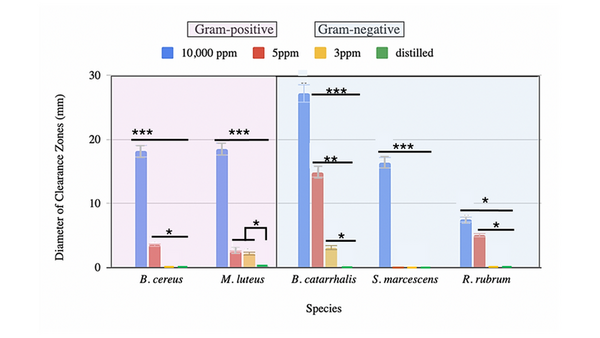
With an estimated one billion dollars loss in the US each year, pathogenic bacteria cause devastating losses in fruit tree orchards, vineyards, and food crops. Treatments rely on five major antibiotics, out of these the most common treatments used world-wide to suppress plant pathogenic bacteria include: streptomycin, oxytetracycline, kasugamycin, oxolinic acid and gentamicin. However, continuous applications of antibiotics to plants exert selective pressure on plant-associated bacteria, leading to the development of antibiotic resistance. This has given rise to the development of treatments using bactericidal nano-metals, such as Copper, Zinc, Magnesium and Silver Therefore, this study evaluates if a low-voltage Do-It-Yourself (DIY) method will produce silver solutions with antibacterial activity. We hypothesize that DIY colloidal silver at 3 ppm will inhibit the growth of Gram-negative crop pathogens (e.g., Serratia marcescens) and Gram-positive pathogens (e.g., Bacillus cereus) more effectively than water, but less than the commercial AgNP at 1,000 ppm. Treatment effects were compared to a positive control of 1,000 ppm silver nanoparticles via the Kirby-Baur method. This is a commercially available silver solution known to kill bacteria species. AgNP treatments were: 1,000 ppm AgNP (positive control); 5 ppm AgNP, 3 ppm AgNP; and negative blank water control. The efficacy was compared across three Gram-negative and two Gram-positive bacteria species. The positive control solution, 1,000 ppm AgNP, was the most effective bactericide across all bacteria species, interestingly the 5 ppm treatment produced zones of clearance half the size of the positive control for two of the Gram-negative species. Activity at 5 ppm suggests that simple DIY systems can produce effective low-cost, bactericidal nano-silver solutions. Further improvements of DIY methods may provide low-cost treatment solutions against some bacteria species.
This article has been tagged with: