Impact of contamination variability on convolutional neural network accuracy in recycling classification
(1) T.C. Jasper High School, (2) Technical Program Manager, Outcomes
https://doi.org/10.59720/25-080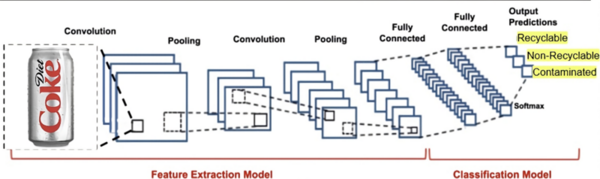
Recycling plays an important role in reducing waste and saving resources. But if recyclables aren't sorted correctly, a lot of material that could have been reused ends up in landfills. Even small bits of food or grease can contaminate recyclable items and make them hard to process. The efficacy of recycling programs relies upon effective sorting with machine learning solutions, increasingly providing solutions. Although convolutional neural networks (CNN) offer a baseline for automated waste classification, recycling bins are often contaminated. Contamination, whether food scraps, oils, or a persistent failure of the consumers to understand non-recyclability, alters the critical visual features needed for CNN classification, leading to higher misclassification rates. Therefore, this study aimed to determine whether increased levels of contamination may decrease classification accuracy by increasing the percentage of contaminant-recognizable recyclables classified as non-recyclables. Accordingly, we trained a CNN on images of recyclables, non-recyclables, and contaminated recyclables of varying contamination levels, then tested a held-out dataset to measure classification accuracy based on contamination severity. Our results indicated a significant inverse relationship between contamination levels and classification accuracy, suggesting that higher contamination is associated with reduced CNN performance. These findings suggest that contamination substantially interferes with feature extraction in CNN-based classification, deepening the need for improved preprocessing strategies in machine-learning-assisted waste management systems.
This article has been tagged with: