Examination of the rotation curve for the dark matter deficient relic galaxy NGC 1277
(1) Institut Moisès Broggi, (2) Departament de Física, EEBE, Universitat Politècnica de Catalunya, (3) Lund Observatory, Division of Astrophysics, Department of Physics, Lund University, (4) Centro Nacional de Análisis Genómico (CNAG); Universitat de Barcelona (UB)
https://doi.org/10.59720/25-050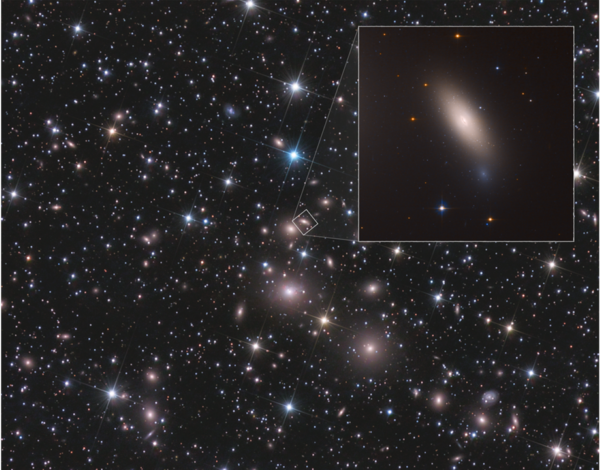
Most galaxies exhibit flat rotation curves, indicating the presence of dark matter. However, recent observations reveal outlier galaxies exhibiting more Keplerian rotation curves, suggesting they have negligible amounts of dark matter. Here we reexamine the galactic kinematics of relic galaxy NGC 1277, a galaxy recently identified as deficient in dark matter, through a reproduction of the rotation curve, using data from the George and Cynthia Mitchell Spectrograph. We hypothesized that its galactic rotation curve could be used on its own to closely model its mass distribution. However, we calculate a total mass of 5.8×10¹⁰ M☉ within five effective radii, three times lower than the current predicted mass, showing that rotation curves do not account for all mass within a specified orbit. To understand the difference between our result and previous results, we consider different sources of error in our computation, such as inclination angle, bulge-disk geometry, velocity dispersion, and the possibility of an over-massive black hole. Our study shows how the shape of a rotation curve of a compact lenticular galaxy is not as closely dependent on its dark matter fraction as previously assumed, as well as the importance of modelling its shape and stellar composition for determination of its mass distribution. This has important implications for the utility of rotation curves for the discovery of additional galaxies with anomalous dark matter fractions.
This article has been tagged with: