Evaluating the relationship between United States housing prices and United States markets
(1) Elkins High School, (2) Encore Capital
https://doi.org/10.59720/25-048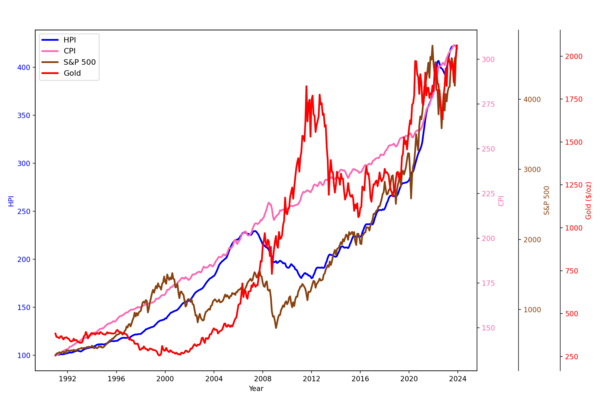
Policymakers often design policies based on forecasts for specific markets, but these forecasts don’t always match the broad trends across sector-wide movements. As a result, the policies can misallocate resources or even worsen economic outcomes when applied in contexts that require a larger lens. We aimed to find a correlation between the various U.S. markets and the housing market to create more accurate predictions. We selected to compare the stock, commodity, and consumer markets because they represent the major pillars of economic activity. Data was collected from publicly available sources including government sites. After formatting the datasets, we performed Pearson correlation analyses with different offset periods to determine how changes in one market preceded or followed another. With our base comparator being the housing market, we hypothesized that the housing market would be positively correlated with all U.S. markets. Our results supported our hypothesis, showing that each of the specified sectors — the stock, commodity, and consumer markets — had a correlation coefficient >0.80 when compared to the housing market. Interestingly, we also found that the housing market led the S&P 500 by 16 months. This would suggest that the housing market can be used to predict the stock market: specifically, when the housing market peaks, the S&P 500 should peak 16 months later. Our findings suggest that correlations and lag patterns between the US housing market and other economic sectors could be leveraged to improve forecasts, providing economic policymakers with more reliable guidance.
This article has been tagged with: