The growth of bacteria on everyday objects and the antimicrobial effects of household spices
(1) Basis Flagstaff High School, (2) Harmony School of Endeavor, (3) University of Delaware
https://doi.org/10.59720/24-368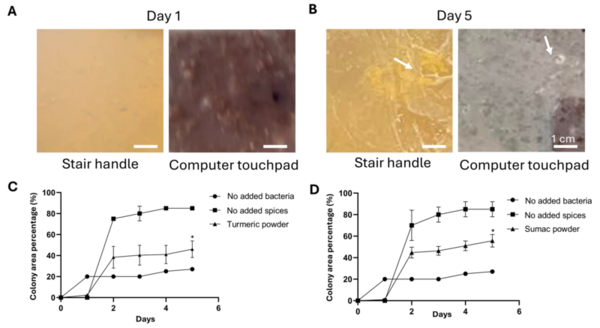
Bacteria are found on everyday objects, where they survive for days to weeks, potentially affecting human health. However, our understanding of bacterial resilience and its interaction with everyday surfaces is limited. This study explored the antimicrobial properties of household spices against bacteria obtained from commonly used, everyday objects. We hypothesized that among select items (cellphone, door handle, computer touchpad, and stair handle), certain surfaces, such as the door handle and computer touchpad, would allow for greater net bacterial growth than others, and that household spices (honey, chili powder, turmeric, and sumac) would inhibit bacterial growth at different rates. We conducted two independent experiments. The first experiment evaluated the effect of honey and chili powder on the growth of bacteria isolated from a cellphone screen and a door handle. The second experiment examined how turmeric and sumac impacted the growth of bacteria isolated from a stair handle and a computer touchpad. The results showed that the bacteria collected from the door and stair handles grew faster than those from the cellphone screen and computer touchpad surfaces. While all spices exhibited inhibitory effects compared to the no-treatment conditions, chili powder and turmeric revealed stronger inhibitory effects compared to honey and sumac. These findings indicate that household spices offer protective antibacterial properties. These household spices could represent promising natural and readily available alternatives to chemical disinfectants.
This article has been tagged with: