Investigating toxicity and antimicrobial properties of silver nanoparticles in Escherichia coli and Drosophila melanogaster
(1) Walton High School
https://doi.org/10.59720/24-362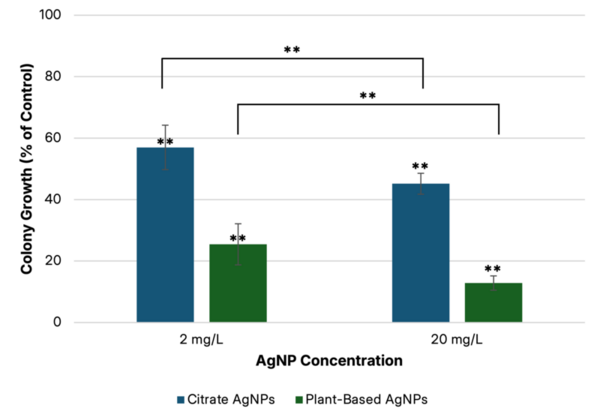
Silver nanoparticles (AgNPs) hold significant promise as an antimicrobial agent and in various biomedical applications. However, AgNPs have toxic health effects linked to their structural properties, such as surface coating, concentration, and size. These properties, when studied in isolation and in combination, must be examined to determine the optimal configuration that minimizes toxicity and maximizes the efficacy of AgNPs for medical applications. This study investigated the toxicity of AgNPs with varying sizes, concentrations, and surface coatings. The toxic effects of citrate-capped and plant-based AgNPs were studied on two model organisms: a species of bacteria, Escherichia coli (E. coli); and the fruit fly, Drosophila melanogaster (D. melanogaster). The research was guided by three hypotheses: AgNPs would be toxic to E. coli and D. melanogaster, although toxicity would decrease with increasing nanoparticle size and decreasing concentration; D. melanogaster would be more resilient to AgNPs than E. coli; and plant-based AgNPs would have higher toxicity to E. coli and lower toxicity to D. melanogaster than citrate-capped AgNPs. The results showed that smaller-sized citrate-capped AgNPs were highly toxic to E. coli even at low concentrations (2 mg/L), while being safer for D. melanogaster. It was also found that plant-based AgNPs were more toxic to E. coli. Overall, the findings suggest that AgNP toxicity can be modulated by adjusting their size, surface coating, and concentration. These findings highlight the potential of AgNPs in medical applications, paving the way for innovative antimicrobial and therapeutic products.
This article has been tagged with: