Decline in vocabulary richness in individuals with Alzheimer's disease
(1) Louis Riel School, (2) Department of Communication Sciences and Disorders, University of Alberta
https://doi.org/10.59720/24-289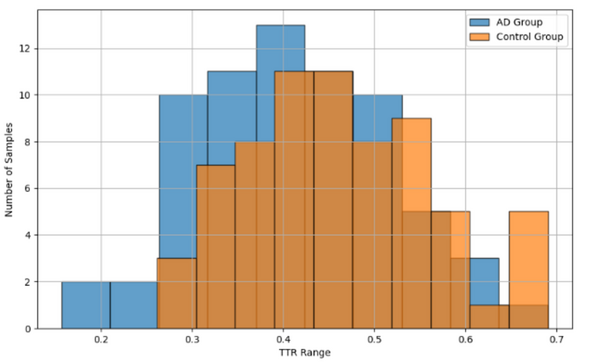
Alzheimer’s disease (AD) is a progressive neurodegenerative disease that is projected to affect 955,900 Canadians by 2030. AD causes the buildup of amyloid-beta plaques and tau tangles in the brain. As a result, individuals diagnosed often face language impairments such as word finding difficulties (anomia), increased repetition, perseverations, diminished vocabularies, echolalia, and verbal apraxia. Characterizing language impairment in AD may aid in the development of non-invasive diagnostic tools using machine learning. In this study, we assessed vocabulary richness in individuals with and without AD. We hypothesized that individuals with AD would have decreased vocabulary richness compared to those without due to language impairment. Our study used publicly available data from DementiaBank, specifically the Pitt corpus, which contains interview transcripts of 136 participants describing the “Cookie Theft” picture from the Boston Diagnostic Aphasia Examination. Results indicate that Type Token Ratio, a measure of vocabulary richness, was lower in participants with AD when compared to participants without AD based on picture description transcripts (p=0.007). However, the effect size was found to be small to medium (d=-0.46). Language impairments occurred less frequently in individuals with AD than hypothesized likely because the picture description task did not sufficiently engage memory. Even though the results we observed came from tasks that were not memory dependent, vocabulary richness may still be a useful indicator of AD and may be useful in automated detection of AD through language.
This article has been tagged with: