Exotropia detection using computer vision, image processing and facial landmark detection
(1) Redmond High School
https://doi.org/10.59720/24-285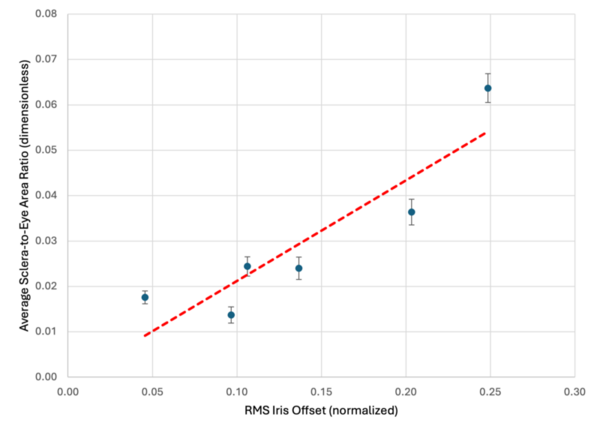
Strabismus is a common medical condition where both eyes are misaligned at the same time. As a form of strabismus, exotropia is a medical condition where the eye deviates outward, impacting 4.6% of adults over 20 years old and 1% of individuals under 20 years old. This condition can cause various visual and cognitive issues. Current medical protocols for assessing the degree of exotropia, such as the prism cover test, are subjective and take time to perform, making early detection and treatment challenging. Our study investigated the use of computer vision techniques for assessing the degree of exotropia quantitatively. We hypothesized that the ratio of visible sclera area to total eye area would positively correlate with the root mean square (RMS) of the iris offsets from both eyes. We used Open CV and dlib libraries to analyze images of a subject with varying degrees of simulated exotropia. Our results showed a strong positive correlation between RMS iris offset and visible sclera-to-eye area ratio (r = 0.905, p = 0.0131), with a 2.8% increase in visible sclera ratio per 0.05 increase in RMS offset. These findings suggest our approach of using computer vision to calculate the sclera to eye area ratio could provide a new, quantifiable method for assessing the degree of exotropia. This could supplement current medical protocols to measure and assess exotropia, making tracking and monitoring of exotropia easier, helping patients worldwide.
This article has been tagged with: