Using advanced machine learning and voice analysis features for Parkinson’s disease progression prediction
(1) Redmond High Schoo, (2) Redmond High School
https://doi.org/10.59720/24-284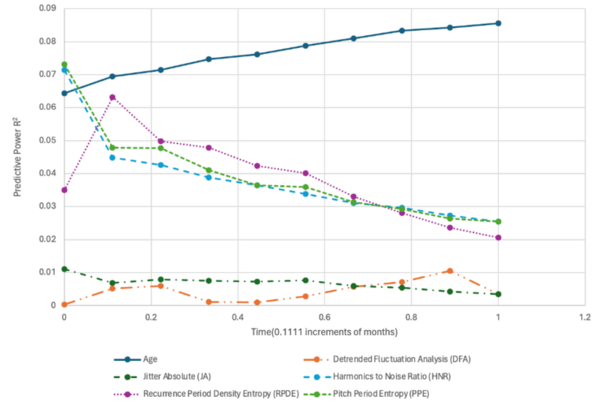
Parkinson’s disease (PD) is a neurodegenerative disease that is important to diagnose early for appropriate treatment. Decline in voice quality is an early symptom of PD, and prior studies have used machine learning models to analyze audio clips and monitor for progression of PD. We hypothesized that the voice features Harmonics to Noise Ratio (HNR), Detrended Fluctuation Analysis (DFA), and Jitter Absolute (JA) would be most useful in detecting PD progression represented by a Unified Parkinson's Disease Rating Scale (UPDRS) and that the relationship between these features and UPDRS scores would be nonlinear given the complexity of PD. We used the publicly available PD telemonitoring dataset from the UCI (University of California Irvine) Machine Learning Repository to validate our hypothesis. After controlling for age, we identified DFA, HNR and JA as the best factors to predict motor and total UPDRS scores, with accuracy measured by MAE and MSE. DFA was the most effective to use in advanced machine learning to accurately predict high motor and total UPDRS scores. We also identified random forest as the best possible model to predict PD progression. We concluded that random forest performed the best as it was a non-linear model, emphasizing the importance of non-linear relationships found in voice features of PD patients, given that PD is a complex disease impacting multiple neural systems with varying degrees of progression. Our study has potential to help clinicians identify progression of PD and manage diagnosis in a non-invasive manner while also providing insights into diagnosis.
This article has been tagged with: