An evaluation of the trends in U.S. maternal deaths based on abortion policies from 2018 to 2021
(1) Redmond High School, (2) Department of Population, Family and Reproductive Health, Johns Hopkins School of Public Health
https://doi.org/10.59720/24-263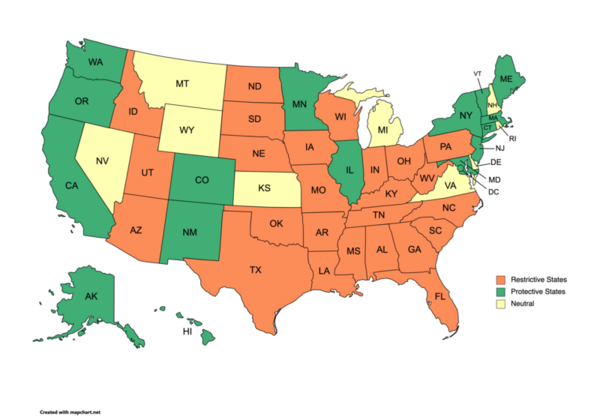
Maternal deaths in the United States (U.S.) are increasing. Even though abortion is recognized as a safe component of health care to save a mother’s life, it is highly regulated in the U.S. where many states have adopted abortion restriction laws. In 2021, more abortion restrictions were enacted by U.S. states than any year since 1973. Our objective was to evaluate the trends in U.S. maternal deaths based on abortion policies in different states from 2018 through 2021. We hypothesized that states with abortion restrictions will have more maternal deaths than states without restrictions. We used the Centers for Disease Control and Prevention Wide-ranging ONline Data for Epidemiologic Research (CDC WONDERS) database to collect maternal deaths and live births in all 50 states from 2018 through 2021. We used policy information published by Guttmacher Institute to categorize the states into three buckets – protective, neutral, and restrictive. We calculated the maternal mortality ratio (MMR), which is maternal deaths per 100,000 live births. We found that the MMR in restrictive states was higher than neutral and protective states every year from 2018 through 2021. The MMR in restrictive states reached the highest value of 58.1 in 2021 (Restrictive 58.1, 95% CI 66.5–49.7; Protective 37.1, 95% CI 48.2–26.02) which showed a 72% increase from 2018. Our results demonstrated an association between abortion restriction and increased MMRs.
This article has been tagged with: