Human comprehension of 4-dimensional rotation
(1) Lexington High School
https://doi.org/10.59720/24-259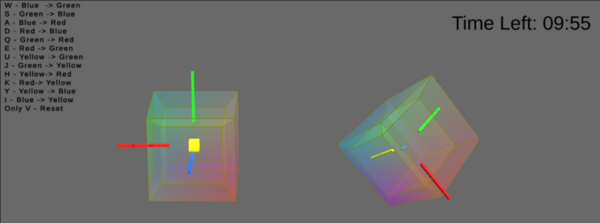
The question of whether people can comprehend four-dimensional (4D) space remains a subject of sparse scientific investigation. This research contributes to understanding the limits of human perception, neuroplasticity, and spatial reasoning. Previous research suggests that with practice, people can improve at 4D tasks, such as determining distance and angles, locating the start of a maze, navigating checkpoints, distinguishing types of motion, and judging inherently 4D properties. However, the ability to mentally rotate a 4D object has not previously been tested. We investigated whether individuals can enhance their comprehension of 4D by practicing the rotation of a 4D cube (hypercube). We aimed to examine the boundaries of human perception and the cognitive prowess in grasping concepts beyond everyday environments by utilizing various simulated models. We hypothesized that participants could improve the number of times they successfully rotated a hypercube to a target rotation in a 4D virtual environment throughout five practice sessions. We saw a trend toward improved 4D rotation after 5 practice sessions (p=0.0767). Among participants who showed early engagement—starting the experiment the same day they watched the introductory video—improvement was statistically significant (p=0.0406). These findings suggest participants may improve their understanding of 4D rotation through repeated practice. This underscores the human mind's adaptability in comprehending abstract concepts when supported by model-based approaches.
This article has been tagged with: