Identifying anxiety and burnout from students facial expressions and demographics using machine learning
(1) Randolph High School, (2) Stanford University
https://doi.org/10.59720/24-195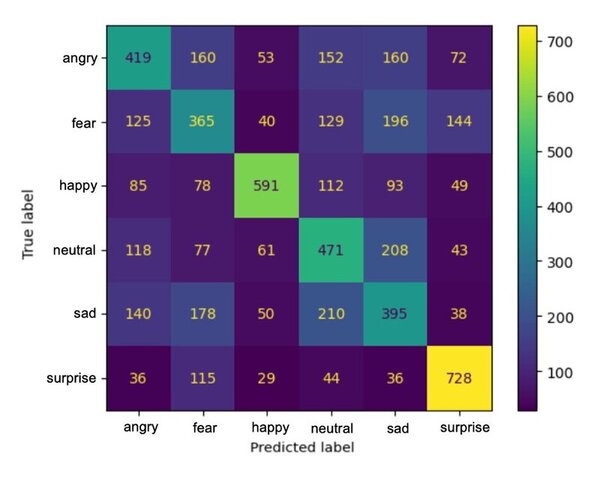
Anxiety is growing among students today and can interfere with a student’s performance or wellbeing, negatively impacting their academic career or their overall quality of life. Thus, it is a pressing issue to distinguish and mitigate this growing mental health crisis, especially among younger students. The first step in doing so is identifying and predicting anxiety before it can significantly impact their lives. Thus, we aimed to determine how we could identify and predict anxiety and burnout in students using both images of their facial expressions and their demographic information. We utilized two classification and two regression machine learning models trained on two different datasets: one dataset containing images of facial expressions and the other containing demographic information and self-reported metrics. We hypothesized that working with image data using a CNN would more accurately identify anxiety than models trained on demographic data, including classification models like the KNN and regression models. Our convolutional neural network (CNN) model was able to identify anxiety in facial expressions correctly with about 81% accuracy. However, our highest performing model trained on the demographic information was our K-nearest neighbors (KNN) model, achieving about 71% accuracy. Thus, although both approaches of analyzing their facial expressions and demographic information can be utilized, the greater accuracy of the CNN confirms our hypothesis that models trained on image data can identify anxiety more accurately than those trained on demographic data.
This article has been tagged with: