Examining the impact of the sympathetic nervous system on short-term memory
(1) Homeschooled, (2) Department of Computational & Applied Mathematics & Statistics, The College of William and Mary, (3) Department of Sociology, The College of William and Mary, (4) Department of Counseling, The University of Oklahoma
https://doi.org/10.59720/24-167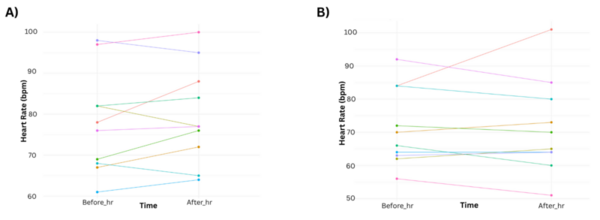
Taking a test can feel like a life-or-death experience with increases in heart rate, sweaty hands, bouncy legs, and a racing mind. These are all signs of the sympathetic nervous system (SNS) kicking into gear. The SNS, which readies the body for fight or flight, is triggered whenever the brain perceives a threat, whether running from a dangerous animal or sitting down to take the SAT. The SNS directly influences bodily functions, which begs the question of its effect on retaining information, specifically addressing our short-term memory. To answer this question, we investigated the relationship between the SNS and short-term memory. We hypothesized that heightened visual awareness, specifically through arousing and intense visual experiences, would enhance short-term memory capabilities. To test this hypothesis, we split 20 participants into two groups. One group watched a calming video, while the other watched an intense, stress-inducing video, followed by a short-term memory test for each participant. Our results indicated that participants who watched the calming video scored slightly higher on the short-term memory test compared to those who watched the intense video. Based on the results of this experiment, we concluded that there was a negative-to-negligible correlation between acute stress and short-term memory. Our findings suggest that while the SNS may heighten visual awareness, the stress it induces has the potential to not affect short-term memory, compared to enhancing it.
This article has been tagged with: