Fire detection using subterranean soil sensors
(1) John P. Stevens High School
https://doi.org/10.59720/24-154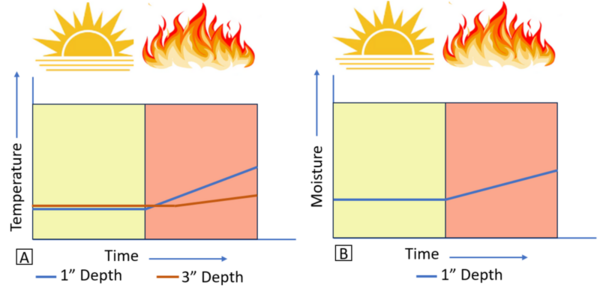
Climate change and the resulting forest fires have devastated communities and caused ecological damage. Damaging fires are often detected very late, or firefighting resources are found lacking, leading to extensive damage. Existing fire detection methods, namely human-based observation, satellite systems, and optical cameras, have low-to-medium reliability. Wireless sensor networks (WSNs) are highly reliable but are plagued by false alarm repetitions. We aimed to engineer a fire detection system using soil-based sensors and mitigate the fire autonomously using harvested rainwater. We hypothesized that under a surface fire, soil temperature and moisture together should increase at a faster rate compared to when there is no surface fire, since under normal conditions, soil temperature should remain stable due to soil’s high volumetric heat capacity. We also hypothesized that soil temperature at a shallow depth should increase faster than at deeper soil depths, since the heat gradient will decrease with depth. We built a WSN consisting of sensor nodes using temperature and moisture sensors deployed at multiple depths. The sensor nodes transmit data to the base station node (BSN) over radio waves. Field testing supported our hypotheses: Soil temperatures remained stable for long periods under normal conditions, but when a surface fire started, the soil temperatures and moisture rose rapidly. Also, the sensor deployed at one-inch depth saw a faster and higher rise in temperatures compared to the sensor deployed at three-inch depth. Therefore, we have developed a low-cost autonomous system that can detect, alert, and activate mitigative actions for communities during fire.
This article has been tagged with: