Predicting clogs in water pipelines using sound sensors and machine learning linear regression
(1) Pate’s Grammar School, (2) Indian Institute of Technology
https://doi.org/10.59720/24-151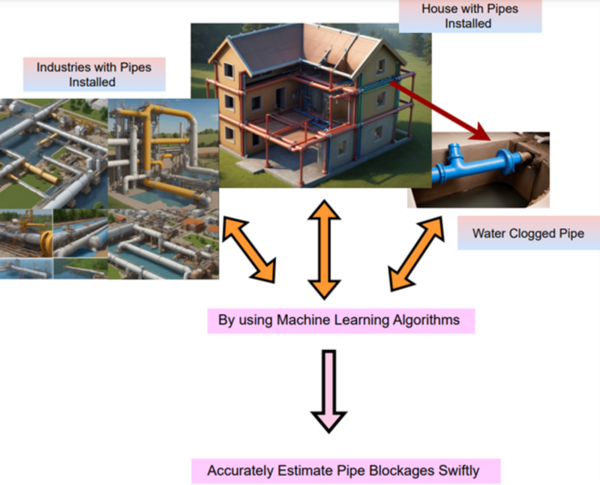
A clog in a water pipe might not seem urgent, but it can escalate to leakages or even burst pipes, posing risks of structural damage. Furthermore, if the clog contains corrosive substances like household or industrial chemicals, it can accelerate pipe deterioration. Leaks resulting from blockages can lead to seepage problems and health hazards associated with living in damp conditions. To tackle these challenges, we aimed to develop a machine-learning algorithm capable of detecting and predicting water pipe blockages in distribution pipelines. We hypothesized that the varying intensity of sound in clean versus blocked pipelines could be utilized to devise a machine-learning algorithm for blockage detection and prediction. To test this hypothesis, we used acoustic sensors to collect data and employed linear regression classification techniques to categorize the data into two sets. We observed substantial variability in sensor readings between clean and blocked pipes. This variability formed the basis for training the machine learning model to identify and forecast pipeline blockages. In this work, the mean square error (MSE) is 5.28 and R2 value of 0.98 for the model evaluated on the testing set. These metrics demonstrate the high accuracy of our model in predicting sensor values. Our results show that the intensity of sound varies in the clogged and clean pipe, and the variation can be used for clog detection.
This article has been tagged with: