Tracking the inhibition of the 5-LOX enzyme under microgravity using FRET
Ethan Liaw (1) and Julie McDonald (2)
(1) William P. Clements High School, Sugar Land, Texas, Cornell University, Ithaca, New York, (2) Massachusetts Institute of Technology, Cambridge, Massachusetts
Abstract
As long-term space travel reaches tangibility, it is crucial to consider the physiological challenges facing astronauts. One challenge is space-induced immune dysfunction, particularly in spacecraft environments where astronauts can encounter threats like multidrug-resistant bacteria.
A contributing mechanism to this dysfunction is increased lymphocyte apoptosis, which stems from the abnormal increase of arachidonate 5-lipoxygenase (5-LOX) activity under microgravity. Notably, 5-LOX expression is not increased.
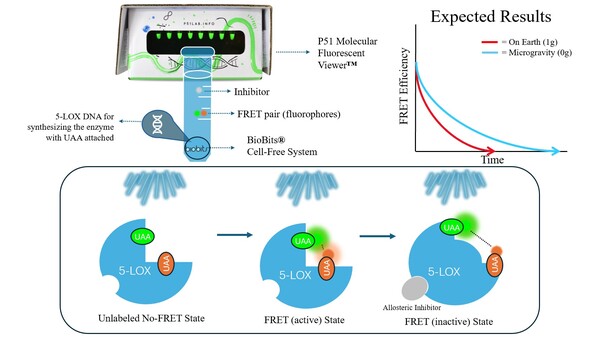
5-LOX is regulated via allosteric inhibition. Thus, we hypothesize that 5-LOX activity increases under microgravity due to slowed inhibition. To test this, our experiment will employ Förster Resonance Energy Transfer (FRET).
Our FRET labeling strategy utilizes BioBits® to synthesize 5-LOX and incorporate unnatural amino acids (UAAs), pAcF and AzK, into minimally disruptive loci on the active site, chosen through analysis of the 5-LOX structure. Using click chemistry, we will label these UAAs with the FRET pair Alexa Fluor 488 hydroxylamine/Alexa Fluor 594 DIBO, respectively. The fluorophores will be positioned within their critical distance, initiating FRET when the donor Alexa Fluor 488 hydroxylamine is excited. Because small molecule inhibitor binding will alter 5-LOX conformation, FRET disruption can act as a proxy for enzyme inhibition.
Our experiment will test on Earth and on spacecraft: 1) an endogenous inhibitor, 2) known chemical/pharmaceutical inhibitors, 3) controls of water only, inhibitor only, and synthesized 5-LOX with UAAs and fluorophores only. Our initial screen of various chemical/pharmaceutical inhibitors will use high concentrations of ligand to determine which inhibits 5-LOX. We will subsequently determine binding affinity of any identified hits by testing inhibition across a range of concentrations.
We hypothesize FRET disruption, and thus 5-LOX inhibition, will occur at a faster rate on Earth than in space. Our study will therefore illuminate microgravity’s influence on 5-LOX inhibition, which could impact our understanding of the biophysics of lipoxygenase protein-ligand binding on Earth and in space.
A contributing mechanism to this dysfunction is increased lymphocyte apoptosis, which stems from the abnormal increase of arachidonate 5-lipoxygenase (5-LOX) activity under microgravity. Notably, 5-LOX expression is not increased.
5-LOX is regulated via allosteric inhibition. Thus, we hypothesize that 5-LOX activity increases under microgravity due to slowed inhibition. To test this, our experiment will employ Förster Resonance Energy Transfer (FRET).
Our FRET labeling strategy utilizes BioBits® to synthesize 5-LOX and incorporate unnatural amino acids (UAAs), pAcF and AzK, into minimally disruptive loci on the active site, chosen through analysis of the 5-LOX structure. Using click chemistry, we will label these UAAs with the FRET pair Alexa Fluor 488 hydroxylamine/Alexa Fluor 594 DIBO, respectively. The fluorophores will be positioned within their critical distance, initiating FRET when the donor Alexa Fluor 488 hydroxylamine is excited. Because small molecule inhibitor binding will alter 5-LOX conformation, FRET disruption can act as a proxy for enzyme inhibition.
Our experiment will test on Earth and on spacecraft: 1) an endogenous inhibitor, 2) known chemical/pharmaceutical inhibitors, 3) controls of water only, inhibitor only, and synthesized 5-LOX with UAAs and fluorophores only. Our initial screen of various chemical/pharmaceutical inhibitors will use high concentrations of ligand to determine which inhibits 5-LOX. We will subsequently determine binding affinity of any identified hits by testing inhibition across a range of concentrations.
We hypothesize FRET disruption, and thus 5-LOX inhibition, will occur at a faster rate on Earth than in space. Our study will therefore illuminate microgravity’s influence on 5-LOX inhibition, which could impact our understanding of the biophysics of lipoxygenase protein-ligand binding on Earth and in space.