Tracking microgravity-induced changes in Heterodimerization to understand Space Anemia
Raymond Le* (1), Jacquelyn Phan* (1), Huy Pham (1), Glenn Li (2), Miranda Lopez (3)
(1) Westminster High School, Westminster, California, (2) Massachusetts Institute of Technology, Cambridge, Massachusetts, (3) University of California, Irvine, California
* These authors made equal contributions
Abstract
Studies conducted on astronauts’ health after their return to Earth have revealed that almost 40% of all astronauts show symptoms of fatigue, reduced cognitive function, and shortness of breath. The condition went undetected until tests showed dangerously low levels of red blood cells (RBCs); a phenomenon known as Space Anemia.
RBC production is stimulated by erythropoetin (EPO), a hormone regulated by the HIF-1 transcription factor formed by the dimerization of two subunits: HIF-1α and HIF-1β. Under normoxic conditions, HIF-1α is tagged for destruction, preventing the heterodimerization of HIF-1α and HIF-1β and thus EPO production. In contrast, when oxygen levels are low, the heterodimer is formed to activate the gene responsible for producing EPO. In space, where astronauts encounter microgravity in addition to hypoxic environments, EPO production remains stagnant, suggesting that the interactions necessary for EPO production are disrupted. Thus, we hypothesize that microgravity reduces the dimerization of HIF-1α and HIF-1β and the function of the resulting heterodimers, ultimately reducing EPO levels and RBC production.
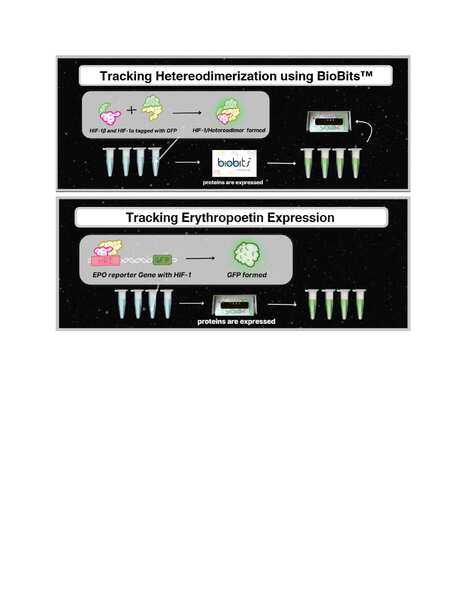
To test this, we will compare the results between cells at normal gravity and those kept in chambers in a microgravity environment on the International Space Station. First, we will measure the dimerization between HIF-1α and ARNT and compare the results between Earth and orbit to determine the effects of microgravity. BioBitsTM will be used to express HIF-1α and ARNT tagged with a split GFP system that will only fluoresce when HIF-1 is formed. Fluorescence observed using the P51 Fluorescence Viewer will indicate that if the dimerization of the proteins has taken place. If we observe the formation of a heterodimer, then we will test the dimer’s ability to act as a transcription factor by activating the EPO gene. To do this, we will be using a modified EPO reporter gene that will produce GFP instead of EPO. The heterodimer is functional if it successfully binds and activates transcription of the gene, leading to the production of green fluorescence visible by the fluorescence viewer.
Our experiment aims to identify how gravitational differences affect the dimerization and functionality of heterodimers, which may further the development of therapeutics necessary for ensuring the safety of our astronauts during and after missions.
RBC production is stimulated by erythropoetin (EPO), a hormone regulated by the HIF-1 transcription factor formed by the dimerization of two subunits: HIF-1α and HIF-1β. Under normoxic conditions, HIF-1α is tagged for destruction, preventing the heterodimerization of HIF-1α and HIF-1β and thus EPO production. In contrast, when oxygen levels are low, the heterodimer is formed to activate the gene responsible for producing EPO. In space, where astronauts encounter microgravity in addition to hypoxic environments, EPO production remains stagnant, suggesting that the interactions necessary for EPO production are disrupted. Thus, we hypothesize that microgravity reduces the dimerization of HIF-1α and HIF-1β and the function of the resulting heterodimers, ultimately reducing EPO levels and RBC production.
To test this, we will compare the results between cells at normal gravity and those kept in chambers in a microgravity environment on the International Space Station. First, we will measure the dimerization between HIF-1α and ARNT and compare the results between Earth and orbit to determine the effects of microgravity. BioBitsTM will be used to express HIF-1α and ARNT tagged with a split GFP system that will only fluoresce when HIF-1 is formed. Fluorescence observed using the P51 Fluorescence Viewer will indicate that if the dimerization of the proteins has taken place. If we observe the formation of a heterodimer, then we will test the dimer’s ability to act as a transcription factor by activating the EPO gene. To do this, we will be using a modified EPO reporter gene that will produce GFP instead of EPO. The heterodimer is functional if it successfully binds and activates transcription of the gene, leading to the production of green fluorescence visible by the fluorescence viewer.
Our experiment aims to identify how gravitational differences affect the dimerization and functionality of heterodimers, which may further the development of therapeutics necessary for ensuring the safety of our astronauts during and after missions.