Counteracting spaceflight-induced bone loss with FSH-blocking antibody
Ronald Chen* (1), Tsz Hang Ko* (1), Farhath Sultana (2), Steven Sims (2), Tony Yuen (2), Mone Zaidi (2), Jessica Quenzer (1), Nicholas Nolan (3)
(1) Stuyvesant High School, New York, New York, (2) Mount Sinai Center for Translational Medicine and Pharmacology, Department of Pharmacological Sciences, and Department of Medicine, Icahn School of Medicine at Mount Sinai, New York, NY, USA, (3) Massachusetts Institute of Technology, Cambridge, Massachusetts
* These authors made equal contributions
Abstract
Spaceflight-induced bone loss poses a significant challenge to astronauts. This increased bone loss is due to various factors unique to the space environment, including microgravity, radiation, and changes in the astronauts’ circadian rhythm. To address this, astronauts have to follow a strict diet and exercise regimen. However, despite these countermeasures, astronauts still experience a 1–2% reduction in bone mineral density per month, more than ten times the bone loss rate of osteoporosis patients on Earth.
Here, we explore how follicle-stimulating hormone (FSH) might play an important role in spaceflight-induced bone loss. While normally recognized as a reproductive hormone with sex-specific functions in gamete development, research on Earth has shown that FSH directly promotes bone resorption, the breakdown of bone. Importantly, FSH levels have also been found to be significantly elevated during the early post-flight period of spaceflight.
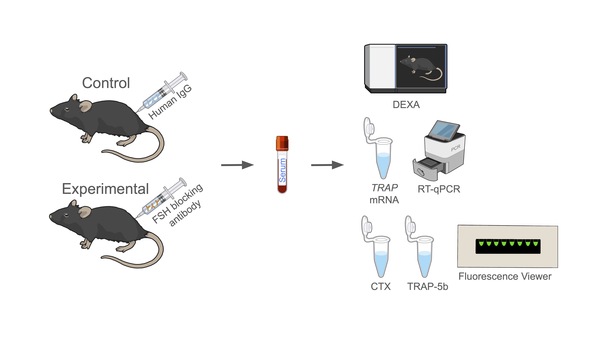
To investigate the effect of FSH on spaceflight-induced bone loss, we will use an FSH-blocking antibody, which has been shown to effectively reduce bone loss on Earth. We hypothesize that the FSH-blocking antibody will also reduce spaceflight-induced bone loss. To test this, two groups of mice will be sent to space, with the experimental group receiving weekly injections of FSH-blocking antibody to prevent excess FSH activity and the control group receiving injections of non-specific human IgG. Blood samples will be collected every week to measure changes in the bone resorption rate. TRAP mRNA levels will be measured with RT-qPCR. Serum CTX and TRAP-5b levels will be measured using a fluorescence viewer and a direct measurement of bone density will be taken using dual-energy X-ray absorptiometry (DEXA) scans.
This experiment would provide insights into the hormonal regulation of bone loss in space and possibly advance the countermeasures for spaceflight-induced bone loss, improving astronaut health, especially as longer space missions are planned.
Here, we explore how follicle-stimulating hormone (FSH) might play an important role in spaceflight-induced bone loss. While normally recognized as a reproductive hormone with sex-specific functions in gamete development, research on Earth has shown that FSH directly promotes bone resorption, the breakdown of bone. Importantly, FSH levels have also been found to be significantly elevated during the early post-flight period of spaceflight.
To investigate the effect of FSH on spaceflight-induced bone loss, we will use an FSH-blocking antibody, which has been shown to effectively reduce bone loss on Earth. We hypothesize that the FSH-blocking antibody will also reduce spaceflight-induced bone loss. To test this, two groups of mice will be sent to space, with the experimental group receiving weekly injections of FSH-blocking antibody to prevent excess FSH activity and the control group receiving injections of non-specific human IgG. Blood samples will be collected every week to measure changes in the bone resorption rate. TRAP mRNA levels will be measured with RT-qPCR. Serum CTX and TRAP-5b levels will be measured using a fluorescence viewer and a direct measurement of bone density will be taken using dual-energy X-ray absorptiometry (DEXA) scans.
This experiment would provide insights into the hormonal regulation of bone loss in space and possibly advance the countermeasures for spaceflight-induced bone loss, improving astronaut health, especially as longer space missions are planned.