Lost in translation: how spaceflight shapes codon usage bias and protein expression
Nitya Johar (1), Steve Gillespie (1), Marissa Morales (2)
(1) Skyline High School, Sammamish, Washington, (2) Massachusetts Institute of Technology, Cambridge, Massachusetts
Abstract
Codon usage bias is the nonrandom utilization of synonymous codons that can influence gene expression efficiency, the rate and accuracy with which genes are transcribed and translated into proteins. Spaceflight causes significant changes in gene expression, reflecting an organism’s response to environmental changes. Stressors such as radiation, mutagenic environments, high temperatures, and nutrient limitation have been shown to alter codon usage bias patterns on Earth, but this phenomenon has never been studied in space. Cosmic radiation and microgravity may alter molecular transport dynamics, thereby influencing codon optimization and the efficiency of protein expression. We anticipate that codon usage patterns in space and Earth will vary, with protein expression being less efficient in microgravity due to the absence of convection which slows down molecular interactions needed for translation.
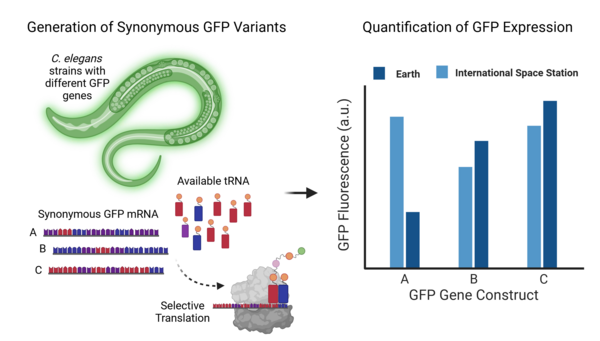
Here, we will generate six genetically modified strains of Caenorhabditis elegans, each carrying different gene constructs of green fluorescent protein (GFP). The GFP gene constructs are designed with synonymous codon sequences spanning Codon Adaptation Indices (CAI) from 0.05 (low predicted expression efficiency) to 0.93 (high predicted expression efficiency). A positive control will be a C. elegans strain that produces GFP using a construct already validated in space, and a negative control will contain wildtype C. elegans with no GFP construct. Samples will be frozen and flown to the International Space Station for experimentation under spaceflight conditions, with replicate samples frozen and studied on Earth for comparison.
After thawing, expression of the GFP gene will be quantified using GFP fluorescence over 36-40 hours using miniPCR bio’s P51 Fluorescence Viewer to determine if codon usage preferences are altered during spaceflight conditions. This research will show how spaceflight affects codon usage bias in multicellular organisms and help create a foundation for future studies informing genetic design strategies for space biology.
Here, we will generate six genetically modified strains of Caenorhabditis elegans, each carrying different gene constructs of green fluorescent protein (GFP). The GFP gene constructs are designed with synonymous codon sequences spanning Codon Adaptation Indices (CAI) from 0.05 (low predicted expression efficiency) to 0.93 (high predicted expression efficiency). A positive control will be a C. elegans strain that produces GFP using a construct already validated in space, and a negative control will contain wildtype C. elegans with no GFP construct. Samples will be frozen and flown to the International Space Station for experimentation under spaceflight conditions, with replicate samples frozen and studied on Earth for comparison.
After thawing, expression of the GFP gene will be quantified using GFP fluorescence over 36-40 hours using miniPCR bio’s P51 Fluorescence Viewer to determine if codon usage preferences are altered during spaceflight conditions. This research will show how spaceflight affects codon usage bias in multicellular organisms and help create a foundation for future studies informing genetic design strategies for space biology.