Sustained ethanol exposure alters baseline locomotor behavior and polyQ aggregation in Caenorhabditis elegans
(1) Phillips Academy
https://doi.org/10.59720/26-078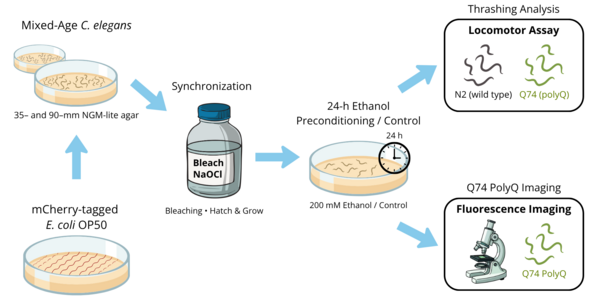
Protein aggregation occurs when misfolded proteins accumulate into larger structures that can interfere with cellular function and are associated with neurodegenerative diseases such as Huntington’s disease. The extent and distribution of aggregation can vary among organisms, suggesting that physiological context may shape proteostatic outcomes. We hypothesized that sustained ethanol exposure would alter aggregate-size distributions and baseline locomotor performance in Caenorhabditis elegans. We exposed young adult wild-type N2 animals and neuronal Q74 animals expressing yellow fluorescent protein (YFP)-tagged polyglutamine (polyQ) containing 74 glutamine repeats to 200 mM ethanol for 24 h, then assessed thrashing and neuronal aggregation after ethanol removal. Median thrashing increased in Q74 animals and decreased in N2 animals following ethanol preconditioning, but neither comparison was statistically significant (Q74: p = 0.171; N2: p = 0.086). In Q74 animals, ethanol-pretreated worms also showed lower median percent aggregate area, a visually left-shifted aggregate-size distribution, and a lower median proportion of large aggregates (operationally defined as ≥30 px2), but these comparisons were not statistically significant (p = 0.193, 0.182, and 0.394, respectively). These patterns suggest that sustained ethanol exposure may be associated with post-exposure differences in baseline locomotor and aggregation phenotypes in C. elegans.
This article has been tagged with: