Increasing MMR vaccination rates substantially reduces measles infections in Gaines County, Texas
(1) Clear Creek High School, (2) University of Delhi
https://doi.org/10.59720/25-288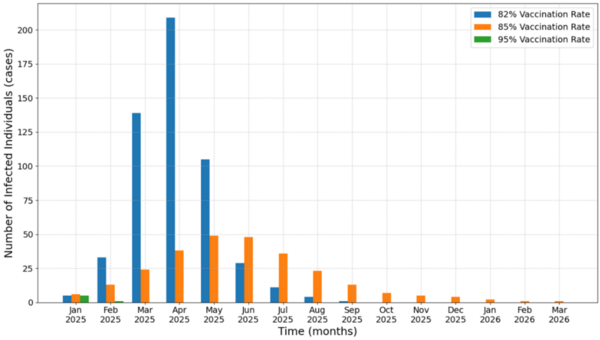
n early 2025, Texas experienced its largest measles outbreak in decades, with Gaines County reporting 413 of the state’s 762 confirmed cases. Despite an estimated 82% measles-mumps-rubella (MMR) vaccination rate, factors such as vaccine hesitancy, safety concerns, and philosophical or religious beliefs contributed to increased transmission. Our study hypothesized that simulations we generated using a Susceptible–Infected–Recovered–Vaccinated (SIRV) model would show that increasing vaccination coverage reduces both the total number of infections and the peak infection burden during an outbreak. Using county-level epidemiological data from the Texas Department of State Health Services, we implemented an SIRV model in Python to simulate measles transmission in Gaines County under different vaccination scenarios. Model results predicted approximately 528 infections at an 82% vaccination rate, decreasing to 261 infections at 85% coverage, and only 6 total cases with an expected outbreak duration of 33 days at 95% vaccination. The analysis revealed a strong inverse relationship between vaccination coverage and burden of infection. These findings indicate that predictive modeling can effectively simulate outbreak dynamics and show how increasing vaccination coverage substantially reduces disease transmission. Because measles outbreaks continue to occur in under-vaccinated communities, these results demonstrate how modeling can inform public health planning and highlight the real-world importance of maintaining high vaccination rates to prevent future outbreaks.
This article has been tagged with: