The influence of economic factors on United States household energy consumption in 2020
(1) Harker School, (2) Sust Global
https://doi.org/10.59720/25-239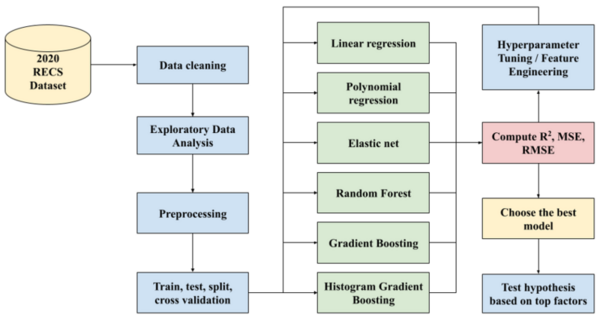
Household energy consumption is a major contributor to both greenhouse gas emissions and overall energy demand. Understanding what factors most influence household energy use is crucial to help policymakers develop more effective energy conservation and pricing strategies. We hypothesized that in 2020, economic factors, specifically the cost of natural gas and electricity, were stronger predictors of U.S. household energy consumption than traditional physical and environmental factors like residence size and climate. To test this hypothesis, we analyzed data from 18,496 households in the 2020 Residential Energy Consumption Survey. We applied several machine learning models including random forest, gradient boosting, and polynomial regression to identify the most significant factors contributing to residential energy use. The gradient boosting model performed the best, explaining 91.1% of the variation in household energy consumption. A detailed analysis of the model's feature importance supported our hypothesis, showing that the cost of natural gas and electricity were the dominant factors influencing energy consumption. These results suggest that energy costs were strongly associated with household energy consumption in 2020. This pattern may reflect increased sensitivity to energy prices during a year marked by economic uncertainty related to the COVID-19 pandemic.
This article has been tagged with: