Stereolithography 3D-printed stents with silica and zirconia nanoparticle reinforcement for intracranial aneurysm treatment
(1) The Woodlands College Park High School, (2) Perelman School of Medicine
https://doi.org/10.59720/25-205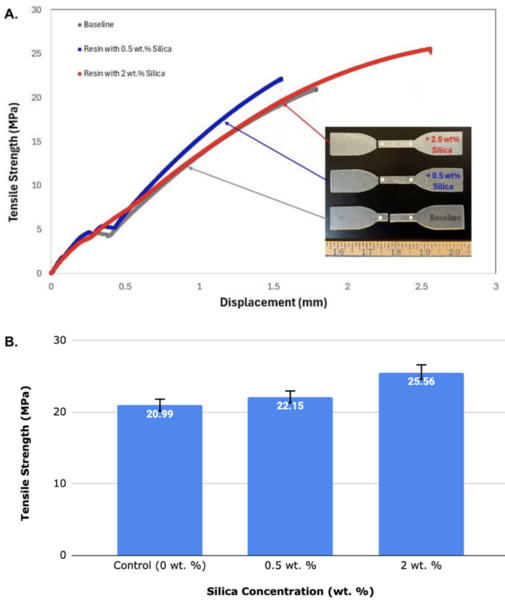
Intracranial aneurysms restrict blood flow in the brain, causing hemorrhages and severe neurological damage. Flow diverter stents (FDSs) are used to redirect blood flow, but current clinical metallic FDSs are associated with risks such as thrombosis, arterial narrowing, and interference with imaging. This study explored whether the mechanical strength and radiopacity (the ability of a material to block X-rays and appear visible under fluoroscopic or radiographic imaging) of stereolithography (SLA) 3D-printed stent materials could be improved through nanoparticle reinforcement. We hypothesized that adding silica nanoparticles would enhance tensile strength and that zirconia nanoparticles would increase radiopacity. Inspired by the principles of bioresorbability, we printed specimens using a biocompatible resin formulation, selected for its compatibility with potential degradable additives and its suitability for future translation to bioresorbable systems. We incorporated silica (0.5 wt.% and 2 wt.%) to enhance mechanical strength, and zirconia (5 wt.% and 10 wt.%) to increase radiopacity. Tensile testing demonstrated that the incorporation of silica nanoparticles increased the ultimate tensile strength of the 3D-printed materials compared with the control, with greater improvements observed at higher silica concentrations. Computed tomography imaging showed enhanced radiopacity, increasing from 63 HU (control) to 132 HU and 176 HU in 5 wt.% and 10 wt.% zirconium-infused stents. Scanning electron microscopy confirmed successful nanoparticle incorporation but also revealed increased agglomeration at higher concentrations. These findings demonstrate that nanoparticle reinforcement can significantly improve the mechanical and imaging properties of SLA-printed stent materials, offering a promising alternative to conventional metallic stents for intracranial aneurysm treatment.
This article has been tagged with: