Innovative fake health news detection: Integrating emotional features into graph neural networks
(1) Princeton International School of Mathematics and Science
https://doi.org/10.59720/25-130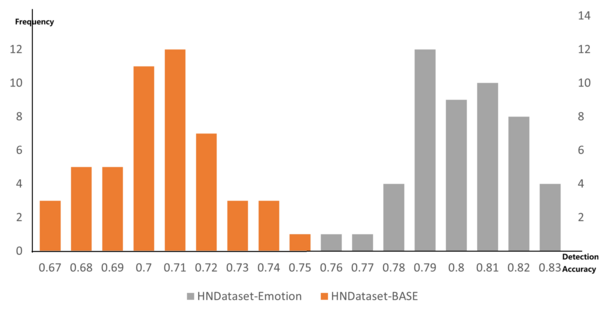
In the digital age, the rapid dissemination of fake health news on social media has posed a serious threat to public health decision-making. Artificial intelligence (AI) has been increasingly used in detecting fake health news by analyzing textual content through models such as recurrent neural networks, long short-term memory, and large language models. However, sequence-based AI models often neglect social context information, limiting their detection performance. To address this limitation, we propose a graph-based model, X-Health News Detection (X-HND), which enhances health-related fake news detection by jointly analyzing textual content and propagation information describing how news spreads among users in the social network. Additionally, we constructed a specialized health-related dataset, Health-News Dataset (HNDataset), for this model. The proposed model integrates graph-based propagation structures with emotion-aware textual features within a domain-specific health dataset, enabling it to capture both how information spreads and how it is expressed. We hypothesize that graph structures incorporating spread paths carry valuable information for fake news detection, while emotional cues in text also improve accuracy. Experimental results comparing different models and datasets indicate that incorporating graph-structured propagation information and emotion features improves fake news detection performance. This research offers a promising new approach for enhancing health misinformation detection through emotionally informed graph modeling.
This article has been tagged with: