Comparative data analysis on the effect of socioeconomic factors on math proficiency
(1) Branksome Hall Asia
https://doi.org/10.59720/25-099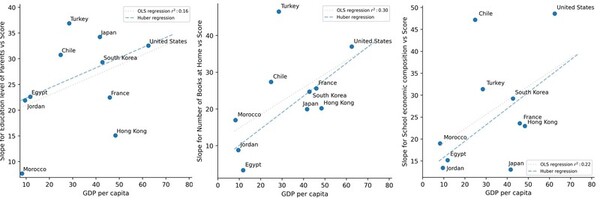
Our study addresses the socioeconomic factors that affect academic achievement and how they differ between various nations. We aim to identify which socioeconomic factors influence academic achievement most heavily and how such achievement is affected by social and economic development factors. We hypothesize that affluent economic backgrounds have a positive correlation with student achievement and the social and economic development level of nations has a positive correlation with how much socioeconomic status (SES) impacts student achievement. Using the Trends in International Mathematics and Science Study (TIMSS) 2019 dataset on mathematics achievement, we conducted multiple regression and statistical testing of the associated regression parameters to analyze the relationship between three socioeconomic status variables. We used Huber regression to analyze the expected marginal utility of each predictor. Overall, we found that inequality in educational achievement increased with the development level. The findings and analyses outlined above suggest key considerations for education policies in both developed and developing nations. For developed nations grappling with education inequality, high priority to correct this inequality should be the mitigation of the impact of SES disparities on academic outcomes. On the other hand, in developing nations, while education is widely recognized as a driver of economic and social progress, policymakers must also be mindful of the risk of exacerbating inequality.
This article has been tagged with: