Measuring the effect of early universe dark matter on the primordial values of helium-4 and deuterium
(1) Irvington High School, (2) Institution of Cosmos Science, University of Barcelona
https://doi.org/10.59720/25-085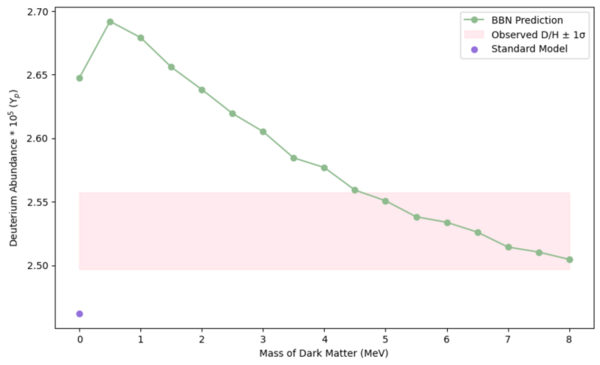
Recent observations of helium-4 and deuterium abundances by the “Extremely Metal-Poor Representatives Explored by the Subaru Survey” (EMPRESS) collaboration may be evidence for an astronomical anomaly. Though the deuterium abundance matched previous observations, the helium-4 abundance was found to be lower than before, conflicting with existing scientific theories. What type of dark matter must have existed in the early universe in order to match observed deuterium and helium-4 abundance values with the theoretical predictions? In our study, we used a customized script of the Python package “PRyMordial” to investigate the effect of the presence of dark matter in the early universe on the primordial abundance values of helium-4 and deuterium to propose a solution to the tension between the theoretical and observed values of helium-4. We used a computer simulation to determine the effect of dark matter particles with varying masses on the primordial abundances of helium-4 and deuterium. We hypothesized that, through computational modeling, adding dark matter particles that are coupled to neutrinos in the early universe could create a match between the observed and theoretical abundance values of deuterium and helium-4, suggesting that this type and mass of dark matter particles could have existed in the early universe during Big Bang Nucleosynthesis. Our proposed model could not match the observed values of helium-4, indicating that inclusion of dark matter coupled to neutrinos is not sufficient to explain the lower levels of helium-4 observed by EMPRESS. To solve the helium-4 tension, further factors in the model of the early universe must be tweaked and explored.
This article has been tagged with: