The relationship between meteorological factors and air quality in Washington D.C. metropolitan area
(1) Thomas Jefferson High School for Science and Technology, (2) Polygence Research Program
https://doi.org/10.59720/25-084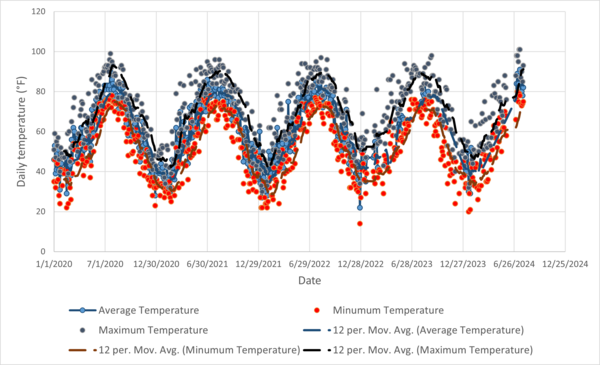
Air pollution can lead to substantial health issues, contributing to 10 percent of deaths worldwide. Past research has shown that meteorological factors influence particulate matter concentrations and, consequently, air quality. We hypothesized that stronger wind speed and higher precipitation improve air quality by dispersing or removing pollutants while higher temperature worsens air quality by increasing ozone and fine particle pollution. We used air quality data from the Environmental Protection Agency (EPA) and meteorological factor data from the National Oceanic and Atmospheric Administration (NOAA) in the Washington D.C. metropolitan area in 2020-2024 to analyze associations between specific weather conditions (wind speed, precipitation, and temperature) and air quality metrics, including fine particulate matter (PM2.5) and Air Quality Index (AQI). We found that wind speed was negatively associated with PM2.5 and AQI (p<0.01). After controlling for seasonality, we found a 1% increase in temperature was associated with 0.56% increase in PM2.5 and 0.51% increase in AQI (R2=0.301 and R2=0.294, respectively). Furthermore, our results suggested that while summer was associated with better air quality than winter, a 1% increase in temperature during summer was associated with a 1.97% increase in PM2.5 and 1.75% increase in AQI (R2=0.301 and R2=0.294, respectively); during winter, a 1% increase in temperature was associated with 1.55% decrease in PM2.5 and 1.43% decrease in AQI (R2=0.301 and R2=0.294, respectively). Our study contributes to improving the understanding of the role of meteorological factors, particularly temperature, in air quality. This is especially important as heat waves become more frequent with global warming.
This article has been tagged with: