Quantitatively evaluating changes in art critique journals’ use of moral language across time
(1) Henry M. Gunn High School, (2) University of Glasgow
https://doi.org/10.59720/25-074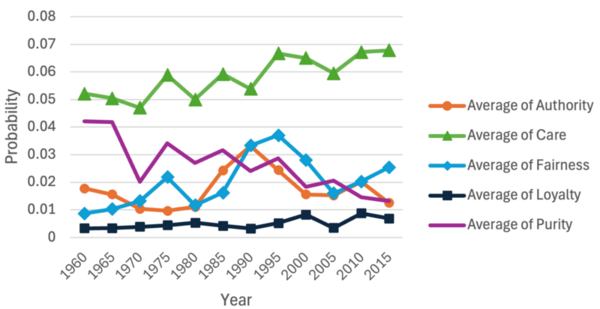
In art journals, art critics examine the connection between the arts and their social contexts. Although sentiment analysis techniques have been applied to articles in this domain, a quantitative evaluation of their moral language has yet to be conducted. We collected approximately 5000 articles from seven art journals published between 1960 and 2015. Relying on the Moral Foundations Theory (MFT) and the Moral Bidirectional Encoder Representations from Transformers (MoralBERT) model, we evaluated trends in the art journals’ moral language throughout this period. The MFT outlines the psychological systems that allow humans to successfully survive and reproduce, and it proposes the existence of “Virtues” and “Vices.” “Virtues” help individuals navigate social relationships and hierarchies, while “Vices” have the opposite effect. MoralBERT outputs values from 0 to 1 for each of 10 “Virtues” and “Vices.” A higher value indicates that the text expresses a foundation to a greater extent. We hypothesized that the average foundation probabilities of the “Virtues” would decrease, while the foundation probabilities of the “Vices” would increase. The results revealed that, although changes across time were limited, the frequency of the “Purity” foundation, which aligns with a desire for sacred cleanliness, decreased. Meanwhile, the “Degradation” and “Care” foundation probabilities increased across time. “Degradation” entails contamination, in both a physical and spiritual sense. The “Care” foundation motivates individuals to alleviate others’ pain through acts of kindness. Overall, this study reveals how artists and art critics’ priorities have shifted across time.