India’s digital public infrastructure: Analyzing UPI and Aadhaar in GDP growth and cost optimization
(1) Heritage International Xperiential School, (2) JD Sports Fashion
https://doi.org/10.59720/25-046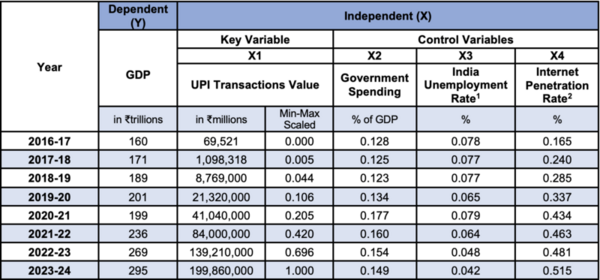
India's Digital Public Infrastructure (DPI) has gained global recognition, with institutions like the International Monetary Fund (IMF) and the Group of Twenty (G20) (IMF) endorsing its model for financial inclusion and public service delivery. DPI comprises the Unified Payments Interface (UPI), a real-time
payments network, and Aadhaar, a biometric ID system for identity verification. Together, they provide
a scalable framework for economic empowerment and governance efficiency. This study quantifies
their macroeconomic impact, hypothesizing that UPI contributes to Gross Domestic Product (GDP) growth primarily through reduced transaction costs, while Aadhaar supports GDP growth through Direct Benefit Transfer (DBT) efficiencies. We conducted regression analyses over an eight-year period (2016–17 to 2023– 24): estimating GDP growth as a function of UPI transaction value, Aadhaar authentication volumes, and Aadhaar Enabled Payment Services (AePS) transaction value, controlling for macroeconomic factors such as unemployment (for labor market fluctuations), government spending (to capture fiscal policy effects), and internet penetration (as a prerequisite for DPI usage). Findings indicate that, on average, UPI contributed an amount equivalent to 3.4% of India’s annual GDP, while Aadhaar’s impact ranged between 2.5% and 4.3% of annual GDP, based on authentication volumes and AePS transaction value, respectively. All effects were statistically significant at the 5% level, with 95% confidence intervals excluding zero. A further analysis compared UPI’s cost savings with cash and cards and assessed Aadhaar-enabled DBT efficiencies. These results underscore DPI’s role as a macroeconomic growth catalyst, emphasizing the need for sustained investment and targeted policy measures to expand its scalability and long-term impact.
This article has been tagged with: