A five-year retrospective analysis of Tuberculosis risk factors and their variability in the United States
(1) James Madison High School, (2) West Hills High School, (3) San Ysidro Health, Duke University, (4) MITRE Corporation
https://doi.org/10.59720/25-027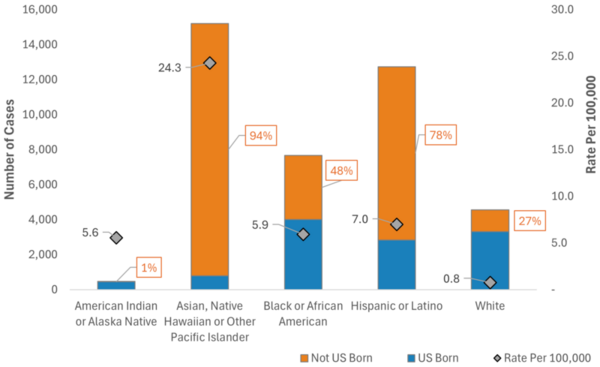
Tuberculosis (TB) persists as a major health concern globally and disproportionately affects non-U.S.-born individuals and certain racial/ethnic groups in the United States. We hypothesized that disparities in TB rates among different racial/ethnic groups in the United States are influenced by a complex interaction of several risk factors including socioeconomic conditions, cultural practices, environmental exposures, and access to public health services. Using the Centers for Disease Control and Prevention Online Tuberculosis Information System database, we analyzed cases and incidence rates of TB from 2018 to 2022, evaluating disparities by demographic and geographic factors and identifying key risk predictors through machine learning models. We also compared this data to the preceding five years (2013-2017) to understand the variability in risk factors over time. Our results revealed that non-U.S.-born individuals accounted for 71.8% of TB cases and experienced much higher incidence rates compared to U.S.-born populations. Racial/ethnic differences were also pronounced, with the highest incidence rates in Asian and Pacific Islanders, while age-related risk varied between U.S.-born and non-U.S.-born groups. Our feature importance analyses identified origin of birth, older age, and male sex as the strongest predictors of TB risk, with variations in predictor significance over time, reflecting evolving TB epidemiology. These findings underscore the need for targeted interventions to reduce TB disparities and improve outcomes in high-risk populations. By addressing the complex relationship of socioeconomic factors, healthcare access, migration, and public health priorities, this research contributes to our understanding of the TB landscape in the United States.
This article has been tagged with: