Rethinking the electric vehicle tax policy: prioritizing affordable solutions for environmental impact
(1) Huron High School, (2) South Pasadena High School, (3) Department of Preventative Medicine, Northwestern University
https://doi.org/10.59720/25-005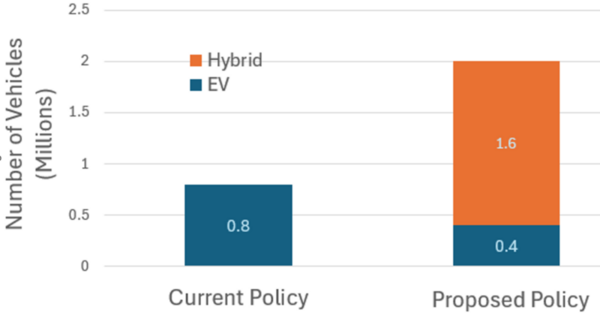
Car emissions present significant risks to both the environment and human health. To reduce greenhouse gas emissions and promote energy-efficient transportation, the United States (U.S.) government introduced a tax credit policy to incentivize income-eligible individuals to purchase electric vehicles (EVs). While the use of EVs reduces carbon emissions, they are expensive, and households that earn at least $200,000 are the primary consumers of EVs. In this study, we propose reallocating tax credit funds to encourage the purchase of hybrid vehicles, which are cheaper than EVs and thus more accessible to lower-income families. Lower-income households often own older, inefficient vehicles, and replacing these with hybrids could significantly reduce emissions. We hypothesized that this new policy would achieve higher fuel economy and reduce carbon emissions more effectively than the current policy. To test our hypothesis, we collected vehicle data from 2022 in the U.S. and analyzed the potential outcomes of fuel efficiency and greenhouse gas emissions of both the current policy and proposed policy changes under different assumptions. Our analysis supported this hypothesis, showing that the proposed policy could yield better outcomes in terms of fuel efficiency, measured in miles per gallon and carbon dioxide emissions. We also suggested that the U.S. government develop a list of eligible vehicles for tax credits, contingent on the trade-in of older, high-emission cars, to maximize environmental benefits. Redirecting EV tax credits towards incentives for hybrids could be a more effective strategy to achieve greater environmental benefits and promote accessibility in sustainable transportation.
This article has been tagged with: